A frozen pipe usually shows up the same way. A cold snap settles in, you turn on the kitchen faucet in the morning, and you get a trickle or nothing at all. In a lot of Saint Paul houses the culprit is a supply line on an outside wall, under a porch, or running through a chilly crawlspace. The good news is that many frozen pipes can be thawed safely if you go slowly.
The bad news is that ice inside a pipe builds pressure, and the split often stays hidden until the ice melts and water starts moving again. That's why thawing is only half the job. This guide walks through how to find the frozen spot, which heat sources are safe, what to have ready before you start, and the clear signs that it's time to stop and call us.
The short version
- Open the faucet and find your main shutoff before you add any heat.
- Use gentle heat only, like a hair dryer, warm towels or a heating pad, starting at the faucet end.
- Never use a torch, open flame or boiling water on a frozen pipe.
- Stop after 30 to 45 minutes, or right away if the pipe is hidden, cracked or the whole house is dry.
- Check for leaks once water flows, then fix the reason the line froze.
How do you know a pipe is frozen and not something else?
The classic sign is one fixture with little or no water while the rest of the house works fine. If the kitchen faucet is dry but the bathroom sink runs, the freeze is somewhere on the line feeding the kitchen. When nothing in the house has water, the problem may be the main service line or the meter, which is a different situation we cover further down.
Look along any exposed pipe you can reach in the basement, a crawlspace, or a sink cabinet. Frost on the outside of the pipe, a slight bulge, or a section that feels much colder than the rest are all good clues. Pipes along rim joists, under kitchen sinks on exterior walls, and near unheated porches or attached garages are the usual suspects in older Minnesota homes.
- Only one faucet, or one side of the house, has no water
- A toilet tank refills slowly or not at all
- Frost or a thin glaze of ice on an exposed pipe
- The weather has stayed below about 20 degrees F for a day or more
- The dry fixture sits on an outside wall or above a cold space
What to do before you add any heat
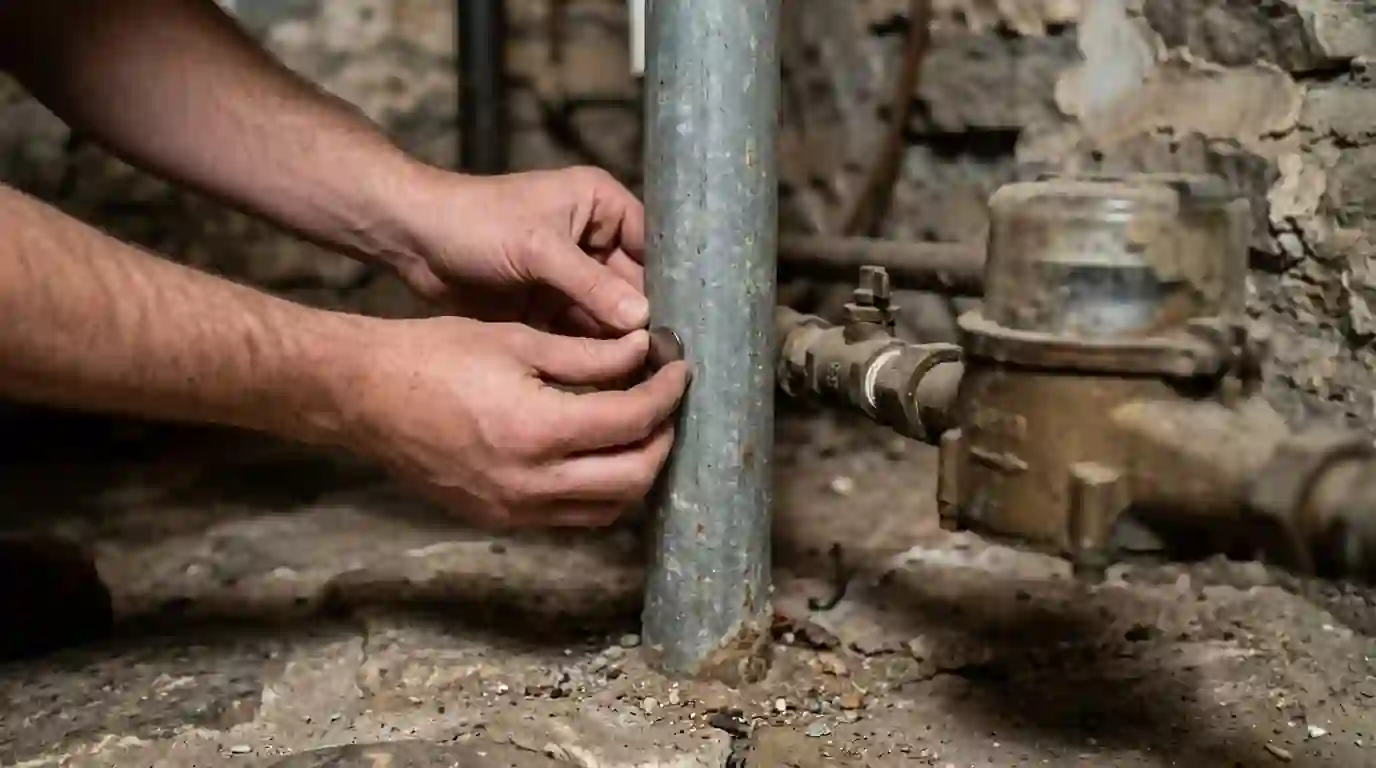
Find your main shutoff valve first. In most Saint Paul basements it sits near the water meter, close to where the service line comes through the foundation wall. Make sure it turns. If the pipe has split, water will pour out the moment the ice softens, and you want to be able to close the main within seconds rather than hunting for it while the floor fills up.
Next, open the faucet the frozen line feeds, both handles if it's a mixing faucet. An open tap gives melting ice somewhere to go and relieves pressure in the pipe. Move boxes, rugs and anything electrical away from the area, and set a bucket and a pile of old towels within easy reach.
Safe ways to thaw an exposed pipe
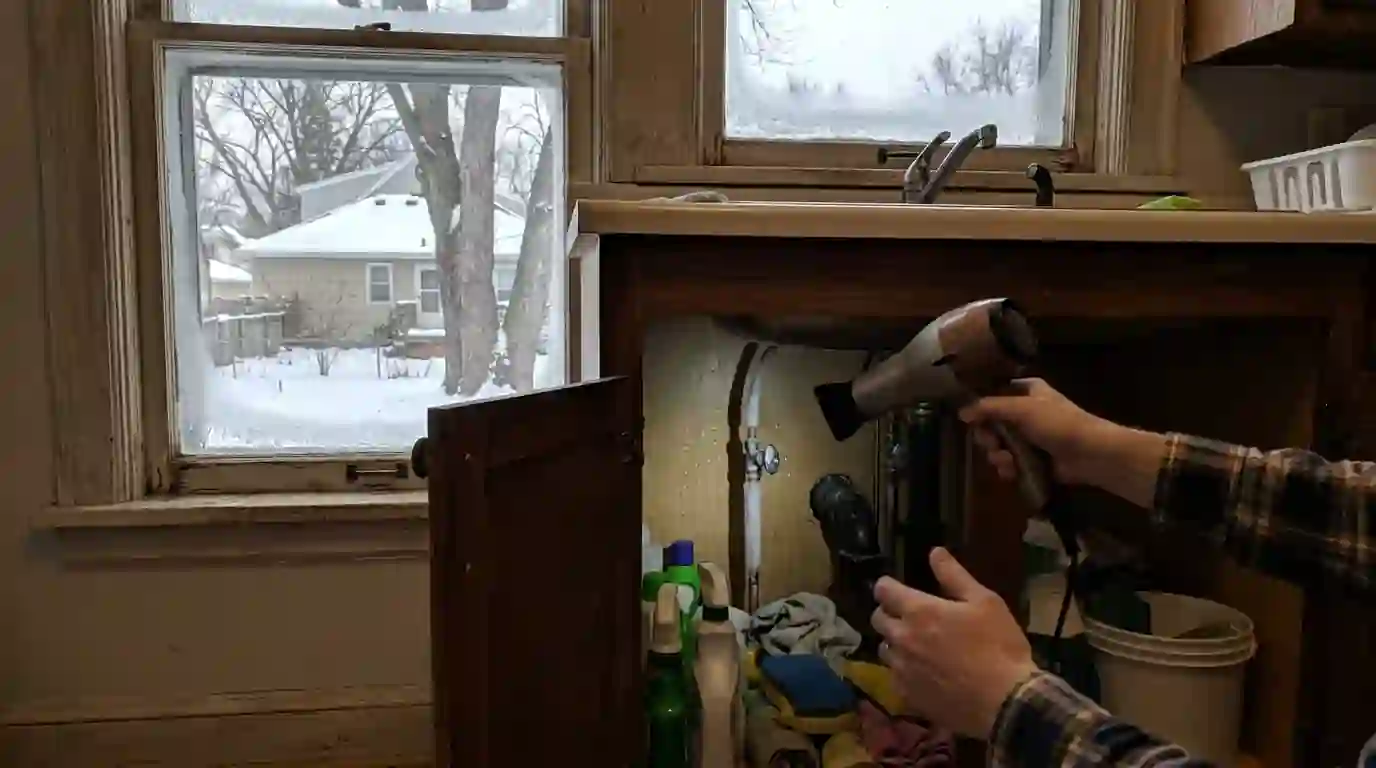
Gentle, steady heat is the whole idea. Start at the faucet end and work back toward the frozen section, so the water you melt has an open path out. A hair dryer on a medium setting, moved slowly along the pipe, works well on copper. Towels soaked in hot tap water and wrapped around the pipe also work, though you'll need to swap them every few minutes.
An electric heating pad or a small space heater aimed at the area can help with a line inside a cabinet. Keep the space heater on a clear floor, a few feet back from boxes, curtains or wood framing, and never leave it running unattended. Plastic PEX and CPVC lines soften with too much heat, so keep the dryer moving and use the lowest setting that still makes progress.
- Hair dryer on low to medium, kept moving along the pipe
- Towels soaked in hot tap water, changed often
- An electric heating pad wrapped around the line
- A space heater aimed into an open cabinet, with clear space around it
- Cabinet doors left open so room heat reaches the pipe
What you should never use on a frozen pipe
Never use a propane torch, a heat gun on high, a kerosene heater or any open flame. A torch can turn trapped water to steam and burst the pipe, it can scorch the framing behind it, and in older homes it can ignite dust, old paper insulation or wood lath inside a wall where you won't see the problem until it's far too late.
Skip the boiling water too. Pouring it over a cold pipe can crack old fittings and scald your hands, and it rarely reaches the frozen section anyway. Don't chip at ice or bang on the pipe to break it loose. And if the pipe sits behind drywall or plaster, don't cut into the wall to get at it. That's the point where the job stops being a homeowner fix.
When it's time to stop and call a plumber
Give a reachable pipe about 30 to 45 minutes of steady, gentle heat. If water doesn't start moving by then, the frozen section is probably somewhere you can't reach, or it's longer than you think. Keep the faucet open, keep the area warm, and call us. We use controlled heat and, for metal lines, electric thawing equipment that warms the pipe from the inside out.
A whole-house freeze is its own case. If the service line froze underground or at the meter, the fix usually involves electric thawing of the buried line, and depending on where the ice sits, the water utility may need to be part of the solution. Don't try to warm the meter or the pipe right next to it with anything stronger than room air.
- You can't find the frozen section, or it's inside a wall, ceiling or floor
- No fixture in the house has water, which points to the service line or meter
- You see a bulge, crack or split anywhere along the pipe
- Water shows up on a ceiling, wall or floor as things start to thaw
- The line runs under a slab, a porch floor or a crawlspace you can't safely enter
What happens once the water flows again?
When flow returns, leave the faucet running at a slow stream for a few minutes and walk the full length of the line you can see. Check the basement ceiling, the cabinet floor and the wall below the fixture. A split often opens right where the ice was thickest, and a tiny weep today can become a steady spray once full pressure is back.
If you find a leak, close the main shutoff and call (651) 215-2087. The line is answered 24/7. Once the pipe is sound, think about why it froze. An open cabinet door, a slow drip on the coldest nights, foam pipe insulation, or a thermostatic heat cable on a line that freezes every year can keep you from repeating this every January.
For a pipe that freezes again and again, the lasting fix is often moving it. We can reroute a supply line away from an exterior wall or porch to the warm side of the house.
Need a hand with this? Call (651) 215-2087. The line is answered 24/7.