Sewer line repair in Saint Paul, MN
When one joint has cracked, sagged or let roots in, you rarely need a whole new sewer. We repair the damaged section, dig or no-dig, and leave the sound pipe in place.
- Phone answered 24/7
- Saint Paul office on E 7th Street
Tell us what you see and hear. We explain the visit and the likely cost on the phone. (651) 215-2087
The short answer
Sewer line repair fixes one damaged section of your lateral, such as a cracked joint, an offset, a root-broken section or a short belly, while the rest of the pipe stays. It makes sense when a camera shows the line is mostly sound. We repair by digging at the spot or by curing a short liner inside. Typical Saint Paul range: $1,870 to $5,870.
When a spot repair is the right fix and when it isn't
A spot repair, sometimes called a point repair, replaces or seals one damaged length of sewer pipe. It's the right call when the camera shows a problem in one or two places and the rest of the pipe still has good walls and tight joints. Fixing three feet of pipe instead of sixty keeps the cost and the mess in proportion to the damage.
It's the wrong call when the whole line is failing. If the camera shows cracks at most joints, heavy scale with thin walls, or roots every few feet, patching one spot just moves the next backup a few feet down the pipe. In that case we'll tell you plainly that full replacement, often trenchless, is the better use of your money.
Either way, we show you the footage. The goal is to fix what's broken now without paying for pipe that still has years left in it.
What sewer line repair costs in Saint Paul
Typical Saint Paul ranges for repairing one section of sewer line. We confirm the price after the camera and locate show the depth and the method that fits.
| Job | Typical range |
|---|---|
| No-dig sectional liner at one joint or crackInstalled through a cleanout | $1,870 to $3,490 |
| Open-cut spot repair in the yardDepth and soil change the cost most | $2,640 to $5,870 |
| Repair under the basement slabIncludes saw cutting and concrete patch | $2,190 to $4,730 |
| Repair near the boulevard or under a walkDeeper digs and hard surfaces to restore | $4,370 to $8,960 |
What moves the price
- Depth of the pipe at the damaged spot
- What's on top: lawn, concrete, pavers, steps or tree roots
- Pipe material and size where the new section joins
- Frozen ground in winter, which slows digging
- Permit, inspection and any restoration of hard surfaces
- Whether the camera finds a second defect worth fixing at the same time
Typical Saint Paul ranges. We confirm your price after we see the job and before work starts. See every price on one page.
How sewer line repair goes, start to finish
Confirm the defect on camera
We camera the line, mark the footage of the damaged section, and make sure there isn't a second problem nearby.
Locate and call in utilities
A sonde reading marks the spot and depth on the surface, and we have buried utilities located before any digging starts.
Expose or prep the pipe
For an open repair we dig to the pipe and support the pit. For a lined repair we clean and jet the section so the liner bonds.
Replace or line the section
We cut in new PVC with shielded couplings, or cure a sectional liner in place across the damaged length.
Camera the finished repair
A second camera run shows clean transitions, no lips, and water flowing smoothly through the repaired section.
Backfill and restore
We backfill in layers, tamp the soil, replace sod or patch the slab, and leave the area as tidy as the ground allows.
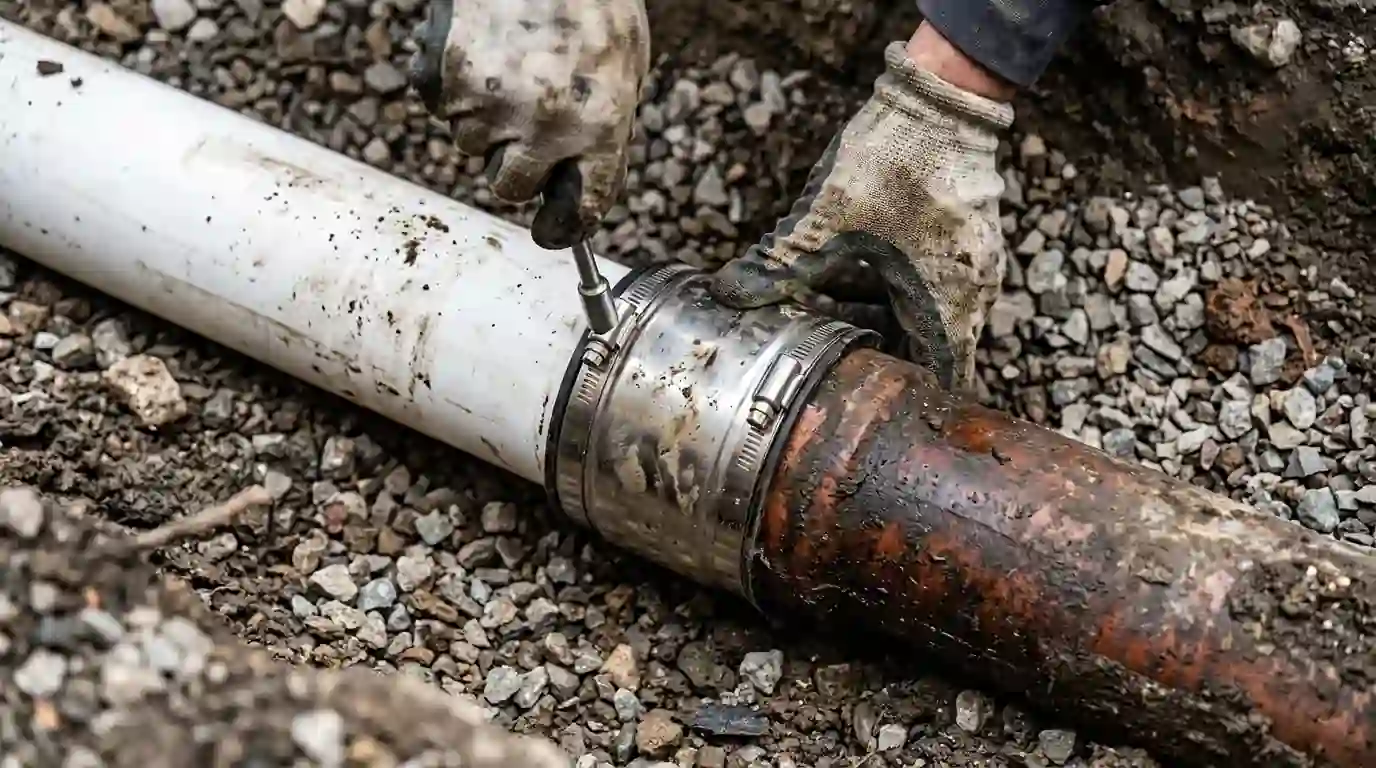
Digging at the break versus lining it from inside
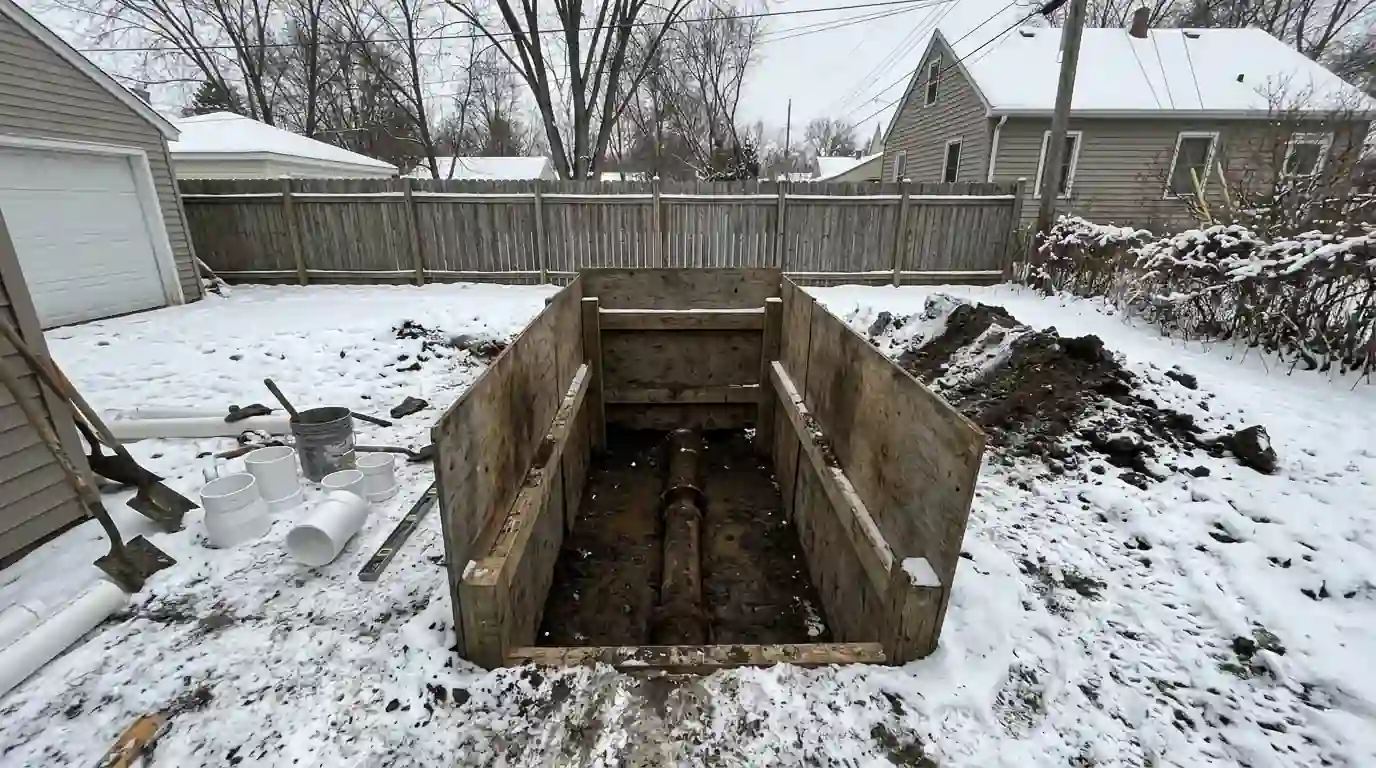
For an open repair we excavate a pit right at the marked spot, cut out the damaged section, and set in new PVC sewer pipe joined to the old pipe with shielded couplings. The pit is usually a few feet wide. We shore it as needed, bed the new pipe on proper gravel so it can't sag, and backfill in layers so the ground settles evenly.
For a no-dig repair we pull a short resin-soaked liner, a few feet long, to the damaged spot through a cleanout. An inflatable bladder presses it against the old pipe while the resin cures into a hard, jointless sleeve. It works well on cracks, small holes and root-prone joints, and it leaves your yard, driveway or finished basement alone.
Each method has limits. A sectional liner can't fix a deep sag or a pipe that's crushed flat, because it follows the shape of the old pipe. An open dig can fix anything but costs more when the break sits under concrete, a big tree, or deep in the ground. We pick the method that fits the defect, not the one that's simpler for us.
What usually breaks one section of a sewer line?
Most single-spot failures we repair come from a handful of causes. Knowing which one you have helps decide whether the repair will last or whether the same thing will happen a few feet away.
A good repair also addresses the cause where it can. If roots cracked the joint, the new section has tight, root-resistant joints. If the pipe sagged because it was bedded on loose fill, we fix the bedding along with the pipe.
- Tree roots forcing apart a clay joint until it cracks
- Ground settling that pulls a joint out of line or leaves a sag
- Cast iron rotting through along the bottom of the pipe
- A fence post, deck footing or utility bore that struck the line
- A failed earlier repair, such as a rubber coupling without a shield
- A cracked section right where the pipe passes through the foundation
What happens to your yard, basement and water use during a repair
With an open repair, expect a pit and a pile of soil for a day or two. We set sod aside when we can and put it back after backfill, though seed or new sod may still be needed. Inside the basement, a repair under the floor means saw cutting the slab, digging to the pipe, and patching the concrete once the new section is in.
While the line is open, the house can't drain. We'll tell you when to stop running water, and on most spot repairs you're without drainage for a few hours, not days. Lined repairs are even shorter, since the resin cure is the longest wait. We pull the city permit the work needs and schedule any inspection.
Signs it is time for sewer line repair
The camera found one bad spot
If an inspection shows a single crack, offset or root mass while the rest of the lateral looks fair, a spot repair is usually the right size of fix.
Roots return to the same joint
Roots that grow back at the same footage after every jetting mean that joint is open and will keep feeding them.
Backups that clear but always come back
A broken section catches paper and waste, so the main clogs again even after a good cleaning.
A sunken strip or soft spot over the line
Soil washing into a break can leave a dip in the lawn or a small hole along the path of the sewer.
Sewer smell near one basement wall
A cracked pipe where the line leaves the house can let sewer gas into the basement even when nothing is backed up.
Water standing in one stretch of pipe
A camera that shows a pool in the line means a sag, which collects solids until it blocks.
Why one joint fails first in older Saint Paul sewers
Prewar homes in neighborhoods like Merriam Park, Como Park and the North End usually drain through clay laterals laid in short sections. The clay itself can last a very long time. The joints are what give out. One joint near a boulevard tree takes on roots, cracks, and starts catching paper, while the clay on either side still looks fine on camera. That pattern is exactly what a spot repair is meant for.
Hills and bluffs add another wrinkle. On sloped lots in Dayton's Bluff and along the West Side, ground movement over decades can pull a joint slightly apart where the grade changes. Winters matter too: digging a repair in January means getting through frozen ground first, so non-urgent repairs are often easier and cheaper in spring, while a full blockage gets fixed whenever it happens.
Where we do sewer line repair
Saint Paul and the surrounding east metro. These are the busiest ZIP codes on our board; the full list has 55 neighborhoods, cities and counties.
Questions about sewer line repair
How do I know if my sewer line needs a spot repair or full replacement?
The camera decides it. If the footage shows damage in one or two places and the pipe walls and joints look solid elsewhere, a spot repair makes sense. If we see cracks, sags or roots along most of the line, spot repairs will keep chasing new failures, and replacement usually costs less in the long run.
How long does a sewer line spot repair take?
Most open repairs in a yard take one day, sometimes two if the pipe is deep or the ground is frozen. A sectional liner usually takes a few hours, with the longest part being the resin cure. Repairs under a basement floor run a day or two, plus time for the concrete patch to set.
Will my lawn be ruined after a sewer line repair?
A spot repair only disturbs the area over the break, usually a pit a few feet across. We cut and set the sod aside when the ground allows and put it back after backfill. Expect a patch that needs watering and maybe some seed. A no-dig liner leaves the yard alone entirely.
Can a sewer line repair be done in a Minnesota winter?
Yes. Emergency repairs happen year round, and we dig through frost when a line is broken or blocked. It takes longer and can cost more because frozen soil has to be broken or thawed first. If the problem isn't urgent, we may suggest waiting for spring, or using a liner that needs no digging at all.
Is a no-dig sectional liner as strong as replacing the sewer pipe?
For cracks, holes and leaking joints, a cured liner makes a hard, jointless sleeve that roots can't get through, and it's built to last decades. It isn't the answer for a deep sag or a crushed pipe, because it follows the old pipe's shape. In those cases we dig and replace the section instead.
Brands we work on in Saint Paul homes
- Kohler
- Moen
- Delta
- American Standard
- Rheem
- A. O. Smith
- Bradford White
- Navien
- Rinnai
- InSinkErator
- Zoeller
- Liberty Pumps
- Watts
- Weil-McLain
Call the Saint Paul office, day or night
A real person picks up at any hour. Tell us what you are seeing, and we will tell you what happens next and roughly what it costs.
(651) 215-2087- Phone
- Answered 24 hours a day, 7 days a week
- Office
- 289 E 7th Street, Saint Paul, MN 55101
- Headquarters
- 50666 229th Ave, Bemidji, MN 56601
- Coverage
- Saint Paul and the east metro, see all areas