Main sewer line clearing in Saint Paul, MN
When the basement floor drain fills up every time someone flushes or the washer drains, the clog is in the main sewer line. We clear it and find out why it formed.
- Phone answered 24/7
- Saint Paul office on E 7th Street
Tell us what you see and hear. We explain the visit and the likely cost on the phone. (651) 215-2087
The short answer
Main sewer line clearing removes blockages from the large pipe that carries all of your home's waste to the city sewer. You need it when several fixtures back up at once or water rises from the basement floor drain. We open the cleanout, run a heavy cable machine with root cutters through the line, confirm full flow and recommend a camera if needed. Typical Saint Paul jobs run $289 to $587.
When main sewer line clearing cannot wait
Floor drain backs up when you use water
Water rising from the basement floor drain during laundry or a shower means everything above it can't get out to the street.
Several fixtures slow at once
When the tub, toilets and sinks all slow down together, the blockage is in the shared main line, not a branch.
Toilet bubbles when the washer drains
Air being pushed back through the toilet as water drains elsewhere points to a main line that's nearly blocked.
Sewage smell in the basement
A steady sewer odor near the floor drain or cleanout can mean wastewater is sitting in the line.
Lowest drain overflows first
Backups show up at the lowest fixture, usually a basement floor drain, shower or laundry tub.
Backups that return every year or two
A main line that clogs on a schedule usually has tree roots growing back through cracked joints.
What blocks a main sewer line?
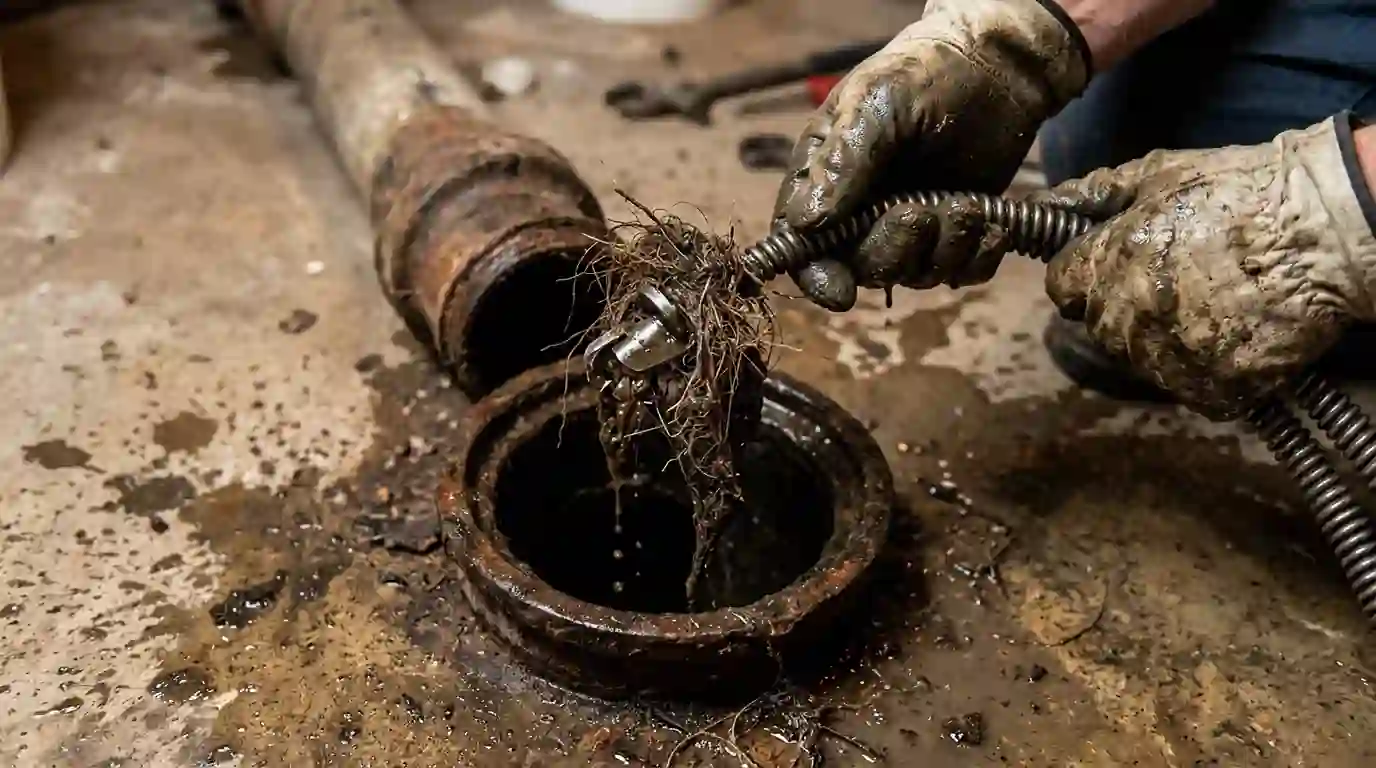
In Saint Paul, the most common answer is tree roots. Older sewer laterals made of clay tile or cast iron have joints every few feet, and over decades those joints shift and crack. Tree roots find the moisture, slip in through tiny gaps, and grow into a mat that catches paper and waste. Mature boulevard trees, especially elms, maples and ash, are often involved.
Other causes include grease that hardens deep in the line, so called flushable wipes that don't break down, a sag where the pipe has settled and holds waste, or a section of pipe that has cracked or collapsed. Each one needs a slightly different approach, so we pay attention to what comes back on the cable.
How we handle main sewer line clearing once we arrive
Confirm it's the main line
We check which fixtures back up and where water rises to confirm the blockage is in the main sewer.
Open the cleanout
We open the main cleanout carefully, drain backed up water, and protect the floor around it.
Run the cable machine
We send a heavy cable with root cutters through the line to the city main until the blockage is gone.
Flow test the line
We run high volume water from upstairs fixtures and watch the floor drain to confirm full flow.
Camera if needed
When roots or repeat backups point to damage, we inspect the line with a camera and show you the footage.
Clean and explain
We sanitize the work area, explain what we found, and suggest the next step if the line needs more than clearing.
What main sewer line clearing costs in Saint Paul
These are typical Saint Paul ranges for clearing a main sewer line. The price is confirmed after we see the cleanout and how the line is set up.
| Job | Typical range |
|---|---|
| Main line clearing through an accessible cleanoutCable machine with root cutters to the city main | $289 to $467 |
| Main line clearing through a floor drain or toiletWhen no usable cleanout exists | $347 to $587 |
| Camera inspection after clearingRecorded footage with depth and location markings | $237 to $413 |
| Scheduled root clearing for known root linesPreventive visit every 12 to 24 months | $247 to $393 |
What moves the price
- Whether there's an accessible cleanout or we need to go in through a toilet or floor drain
- Length of the sewer lateral from the house to the city main
- Severity of root intrusion and how many passes it takes
- Pipe material, since clay, cast iron and Orangeburg need different care
- After-hours, weekend or holiday timing during an active backup
- Adding a camera inspection on the same visit
Typical Saint Paul ranges. We confirm your price after we see the job and before work starts. See every price on one page.
How we clear the line, from the cleanout to the street
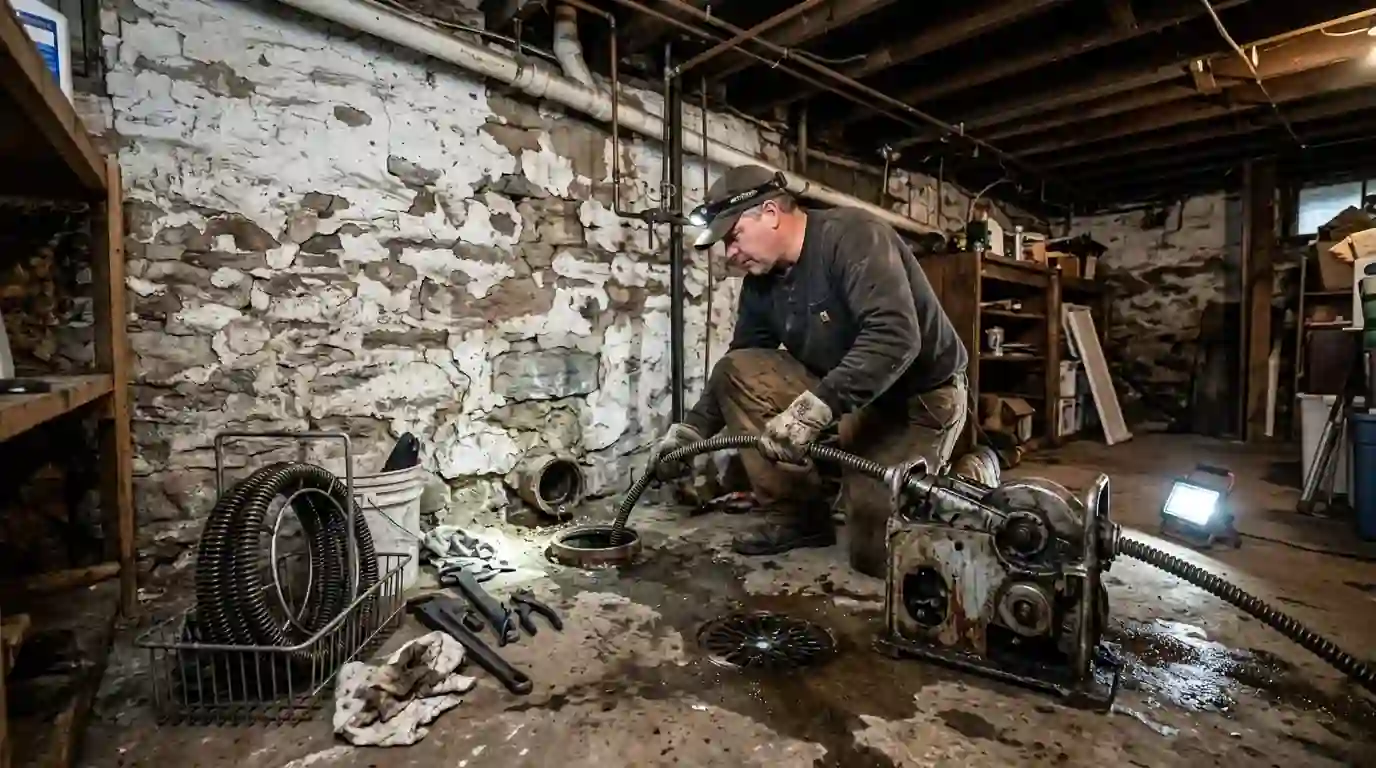
We start at the main cleanout, usually a capped fitting near where the sewer line leaves the house, on the floor or low on the stack. If water is backed up, we open it slowly, since the line may be under pressure, and let it drain into the floor drain or bucket. If there's no accessible cleanout, we go in through the floor drain or pull a toilet.
Then we run a heavy sectional cable machine with a cutting head sized for the pipe, usually four inch, all the way to the city main if needed. Root cutters slice through root mats and open the line to full diameter. We run the cable through the blockage several times and change heads if the first one doesn't clear it fully.
Once water flows, we run a large volume of water through the line from upstairs fixtures to make sure it drains fast, not just slowly enough to stop the backup.
- Open the main cleanout slowly to release backed up water
- Heavy sectional cable machine sized for four inch sewer pipe
- Root cutting heads that open the line to full diameter
- Multiple passes through the blockage
- High volume flow test from upstairs fixtures
Why a camera inspection often follows the clearing
Clearing tells us the line is open today. A camera tells us why it clogged and whether it will clog again soon. We push a waterproof camera through the cleaned line and watch the screen for root intrusion, cracked joints, offset sections, sags and broken pipe. We can record the inspection and mark the depth and location of any problem from the yard.
Not every job needs one. If it's a first backup in a newer line and grease or wipes clearly caused it, a camera may not add much. If roots came back on the cable or this is the second backup in a few years, a camera helps you decide between routine root clearing, spot repair, or replacement. We'll tell you which we'd recommend and why.
Keeping your main line flowing between visits
For root problems, a scheduled clearing every twelve to twenty four months keeps roots from building into a full blockage. It's far less disruptive than a backup in the middle of a holiday weekend. If the camera shows the line is solid other than roots at a few joints, scheduled clearing can work for years.
Inside the house, keep grease out of the kitchen sink, put wipes and paper towels in the trash, and use drain screens in tubs and showers. If the line has a sag or a broken section, those habits help, but eventually a repair or trenchless lining is what ends the backups for good. Once the line is repaired, adding a backwater valve can protect the basement from city sewer surges.
Main sewer line backups in Saint Paul neighborhoods
Many Saint Paul homes were built before World War II, and a large number still have their original clay tile or cast iron sewer laterals running under the front yard to the street. Add decades of growth from boulevard trees, and root intrusion is the most common reason we clear main lines in neighborhoods like Highland Park, Summit Hill, St. Anthony Park and Como Park.
Spring makes it worse. Snowmelt and heavy rain push groundwater into cracked laterals and raise the load on the city sewer, so a line that was barely flowing in winter backs up in April. If your floor drain backs up during heavy rain even when you aren't using water, that's worth a camera look. A backwater valve may help once the line itself is sound.
Where we do main sewer line clearing
Saint Paul and the surrounding east metro. These are the busiest ZIP codes on our board; the full list has 55 neighborhoods, cities and counties.
Questions about main sewer line clearing
What should I do when sewage backs up into my Saint Paul basement?
Stop using water everywhere in the house, including toilets, showers and the washer, so you don't add to the backup. Avoid contact with the sewage, keep kids and pets away, and don't use a household plunger on the floor drain. Call (651) 215-2087. We answer 24/7 and can clear the main line the same day or night.
How do tree roots get into a main sewer line?
Older clay and cast iron sewer pipes have joints every few feet. Over time the ground shifts and those joints open slightly. Roots grow toward the moisture and nutrients, enter through the tiny gaps, and expand into a mat inside the pipe. Clearing cuts them back, but they regrow unless the joints are sealed or the line is lined or replaced.
Is main sewer line clearing the same as hydro jetting?
No. Clearing uses a heavy cable with cutting heads to open the line and cut roots. Hydro jetting uses high pressure water to scour the full inside of the pipe, removing grease, scale and fine roots. Cable clearing is usually first during a backup. Jetting can follow when a line needs a deeper clean.
Who is responsible for the sewer line between my house and the street in Saint Paul?
In most cases, the homeowner owns and maintains the sewer lateral from the house to the connection at the city main. A camera inspection can show where a problem sits. If a blockage turns out to be in the city main itself, we'll tell you so you can contact the city.
Jobs that often go with main sewer line clearing
Brands we work on in Saint Paul homes
- Kohler
- Moen
- Delta
- American Standard
- Rheem
- A. O. Smith
- Bradford White
- Navien
- Rinnai
- InSinkErator
- Zoeller
- Liberty Pumps
- Watts
- Weil-McLain
Call the Saint Paul office, day or night
A real person picks up at any hour. Tell us what you are seeing, and we will tell you what happens next and roughly what it costs.
(651) 215-2087- Phone
- Answered 24 hours a day, 7 days a week
- Office
- 289 E 7th Street, Saint Paul, MN 55101
- Headquarters
- 50666 229th Ave, Bemidji, MN 56601
- Coverage
- Saint Paul and the east metro, see all areas