Whole-house repiping in Saint Paul, MN
Old galvanized pipes rust from the inside, choke your water pressure and start leaking at the threads. Whole-house repiping replaces the supply lines with copper or PEX so every faucet runs strong again.
- Phone answered 24/7
- Saint Paul office on E 7th Street
Tell us what you see and hear. We explain the visit and the likely cost on the phone. (651) 215-2087
The short answer
Whole-house repiping replaces a home's water supply pipes, usually old galvanized steel, with new copper or PEX. You need it when pressure is weak at several fixtures, hot water runs rusty, or leaks keep showing up at fittings. We plan routes that limit wall openings, run new lines, and reconnect every fixture. Typical Saint Paul repipes run $5,470 to $14,830, depending on size and access.
Why galvanized pipe fails from the inside out
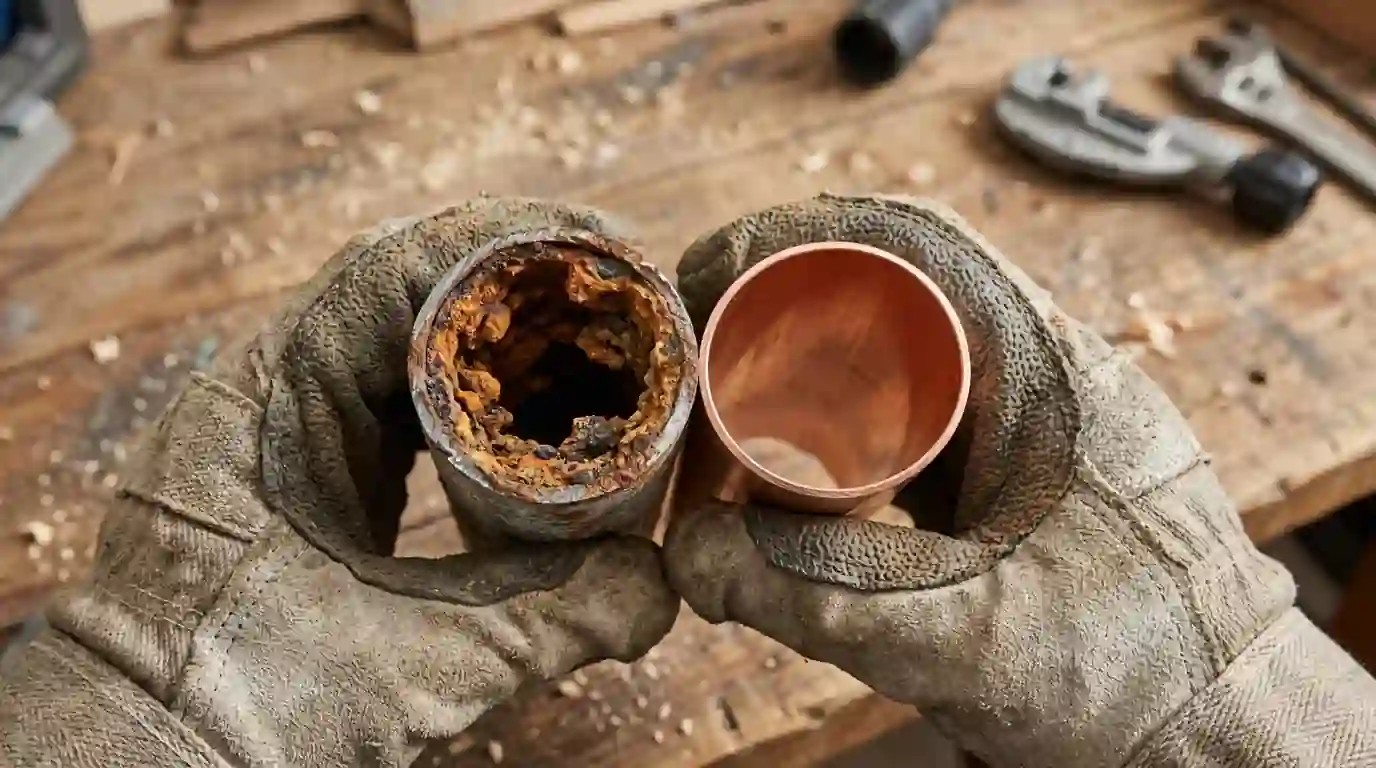
Galvanized steel pipe has a zinc coating meant to slow rust. Over decades the zinc wears away and the steel starts to corrode inside. Rust and mineral deposits build up on the walls, shrinking a half inch pipe down to a pencil sized hole. You feel it as weak flow and see it as discolored water. The outside can look fine while the inside is nearly closed.
Joints are the weak points. Every threaded connection removes metal from the pipe wall, so leaks tend to show up there first. Repairing one leak often disturbs rust nearby and causes another. Galvanized lines can also hold lead in their scale if they were ever downstream of a lead service line, which is one more reason to replace them rather than patch.
What whole-house repiping costs in Saint Paul
These are typical Saint Paul ranges for repiping, not a fixed price. We confirm cost after walking your house and agreeing on scope.
| Job | Typical range |
|---|---|
| One bath home, PEX with copper at mechanicalsBasement and one floor above | $5,470 to $8,390 |
| Two bath, two story homeMost common Saint Paul repipe | $7,960 to $11,840 |
| Larger home or all copper repipeThree baths or more, or full copper | $10,370 to $14,830 |
| Partial repipe of basement mainsBranches upgraded later | $1,870 to $3,640 |
What moves the price
- Number of bathrooms, kitchens and fixtures
- Copper versus PEX or a hybrid
- Plaster walls versus drywall and access routes
- Finished basement ceilings that need opening
- Wall and ceiling patching included or not
- Upgrading the main shutoff, water heater or laundry connections at the same time
Typical Saint Paul ranges. We confirm your price after we see the job and before work starts. See every price on one page.
How whole-house repiping goes, start to finish
Walk the house and map the pipes
We trace existing supply lines from the meter to every fixture and look for easy routes.
Choose materials and plan routes
We go over copper, PEX or a mix, and show you where openings will be needed.
Permit and prep
We pull the city permit, protect floors and furniture and set up dust control.
Run the new lines
We install the new main, distribution and branch lines, working room by room.
Reconnect and test
We tie in every fixture, add new shutoffs, and pressure test the whole system.
Flush, inspect and patch
We flush the lines, meet the inspector and close up openings neatly.
Copper or PEX: which fits your house?
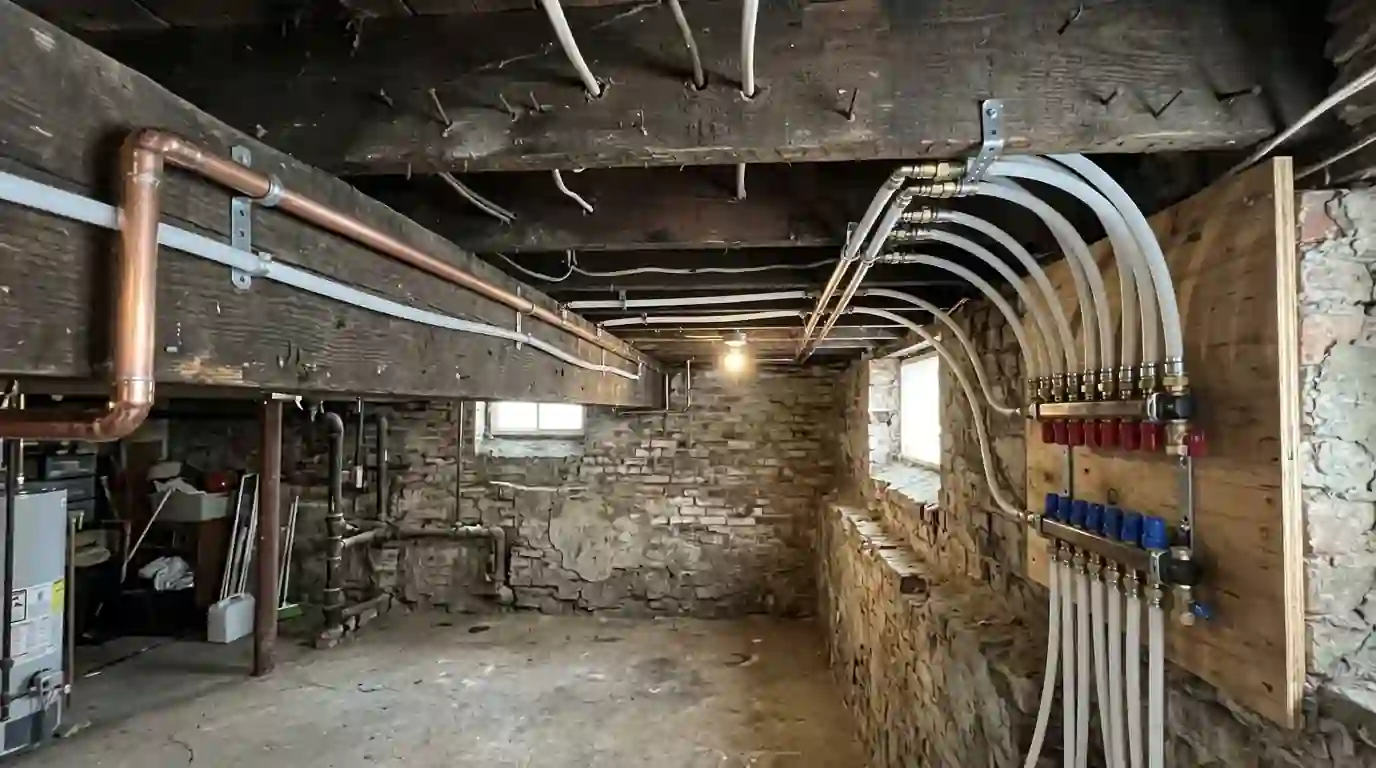
Both are solid choices, and we install both. Copper is rigid, long lasting and handles high heat, and many homeowners like how it looks in an unfinished basement. It costs more in materials and takes more labor to route through finished walls. PEX is flexible plastic tubing that bends around obstacles, needs fewer fittings, and is less likely to burst if it freezes. It usually means fewer wall openings.
Many repipes use both. We might run copper near the water heater and in the basement, where it's exposed, then switch to PEX for the runs that snake up through walls to bathrooms and the kitchen. We often use a manifold for PEX, which gives each fixture its own line and shutoff in one spot, so a single repair doesn't mean shutting water off to the whole house.
- Copper: rigid, heat tolerant, long track record
- PEX: flexible, fewer fittings, fewer wall openings
- Manifold systems: individual shutoffs for each fixture
- Hybrid: copper in the basement, PEX in the walls
How we keep wall openings small
The biggest worry most people have is torn up plaster. We plan routes before cutting anything. Old Saint Paul houses often have chases next to chimneys, in closets or behind stair walls where pipes can run with very little demolition. In balloon framed homes, open stud bays sometimes let us pull lines from basement to attic without opening walls between floors.
When we do need access, we cut small, neat openings at fixtures and where lines change direction. We protect floors and furniture, use dust control, and keep each opening as small as we can. After the repipe, we close the openings with drywall or plaster patches ready for paint, or leave them neat for a finisher you hire if you prefer.
What gets replaced in a whole-house repipe
A full repipe covers the main supply line from the meter, the hot and cold distribution lines throughout the house, and the branch lines to every fixture. We install new shutoff valves under sinks and toilets and new supply lines to fixtures. We also look at the water heater connections, laundry valves and outdoor faucets, and replace those that are worn or corroded.
Some homeowners choose a partial repipe instead, replacing the worst sections first. That can make sense if the main runs are already copper and only branches remain galvanized. We'll tell you plainly what we see, and you can decide the scope. Either way, we pressure test the new system before closing anything up.
Living in the house while we repipe
Most families stay home during a repipe. We plan the work so water is off for as short a time as possible, typically during the day, with service restored each evening when we can. A typical house takes two to five days, depending on size, number of bathrooms and how hard the routes are to reach.
Before starting, we'll walk through the plan, which rooms we'll work in each day, and when water will be off. We pull the city plumbing permit and schedule inspections. At the end, we flush the new lines, check every fixture for flow and leaks, and show you where the new shutoffs are.
Signs it is time for whole-house repiping
Weak pressure at upstairs fixtures
Galvanized pipe narrows as rust builds inside. Second floor showers and sinks lose pressure first.
Brown or orange water, especially hot
Rust breaking loose inside the pipe turns water discolored after it sits or when hot taps are opened.
Leaks at threaded joints
Threads are the thinnest part of galvanized pipe, and that's where pinholes and drips appear first.
A patchwork of pipe types
Copper, galvanized and plastic spliced together over the years often means failures are just being chased one at a time.
Pressure drops when another tap opens
If someone flushing a toilet kills your shower, the pipes can't carry enough flow anymore.
You're remodeling anyway
With walls or ceilings already open for a kitchen or bath, repiping costs less and causes less disruption.
Galvanized pipe in Saint Paul's older homes
A large share of Saint Paul houses were built before World War II, and many were plumbed with galvanized steel supply pipe. Some have been partly updated, but it's common to find a copper main in the basement feeding galvanized branches that disappear into plaster walls. We see this pattern all over Merriam Park, Mac-Groveland and Payne-Phalen, especially in story and a half and two story homes.
Saint Paul's plaster and lath walls make route planning matter. Bungalows in the Midway and foursquares near Como Lake often have chases around chimneys or closets that make repiping easier than people expect. And because pipes on exterior walls are at risk in a Minnesota winter, we route new lines on interior walls wherever possible and insulate any that have to run near cold spots.
Where we do whole-house repiping
Saint Paul and the surrounding east metro. These are the busiest ZIP codes on our board; the full list has 55 neighborhoods, cities and counties.
Questions about whole-house repiping
How long does whole-house repiping take in a Saint Paul home?
Most homes take two to five days. A small bungalow with one bathroom can be done in a couple of days, while a larger two story home with plaster walls and several baths takes longer. We restore water at the end of each workday whenever possible and give you a day by day plan before we start.
Is PEX safe for drinking water?
Yes. PEX tubing made for potable water is widely used in homes across Minnesota. It resists scale and corrosion, and its flexibility gives it some tolerance to freezing. We use PEX rated for drinking water and install it with approved fittings. Some homeowners prefer copper for exposed areas, and we can mix the two.
Can I replace galvanized pipe a little at a time?
You can, but it has drawbacks. Mixing new and old pipe means the remaining galvanized sections keep restricting flow and leaking, and connecting copper directly to steel can cause corrosion unless the right fitting is used. A phased repipe works well if you start with the mains and plan the rest within a year or two.
Will repiping fix low water pressure in my whole house?
If galvanized pipe is the cause, yes, dramatically. But low pressure can also come from a failing pressure reducing valve, a partly closed main shutoff, or a narrow service line. We check each of those before recommending a repipe, so you're not replacing pipes to fix the wrong problem.
Do you patch the walls after repiping?
We close every opening we make with drywall or plaster patches, ready for paint. If you'd rather hire a plasterer or painter yourself, we leave openings neat and tell you exactly where they are. Either way, we keep openings as small as possible and protect your floors and furnishings during the work.
Brands we work on in Saint Paul homes
- Kohler
- Moen
- Delta
- American Standard
- Rheem
- A. O. Smith
- Bradford White
- Navien
- Rinnai
- InSinkErator
- Zoeller
- Liberty Pumps
- Watts
- Weil-McLain
Call the Saint Paul office, day or night
A real person picks up at any hour. Tell us what you are seeing, and we will tell you what happens next and roughly what it costs.
(651) 215-2087- Phone
- Answered 24 hours a day, 7 days a week
- Office
- 289 E 7th Street, Saint Paul, MN 55101
- Headquarters
- 50666 229th Ave, Bemidji, MN 56601
- Coverage
- Saint Paul and the east metro, see all areas