Hydro jetting for drains and sewer lines in Saint Paul, MN
When a drain keeps clogging a few weeks after it was snaked, the pipe wall is usually coated with grease, scale or fine roots. Hydro jetting washes that buildup out so the line runs at full width again.
- Phone answered 24/7
- Saint Paul office on E 7th Street
Tell us what you see and hear. We explain the visit and the likely cost on the phone. (651) 215-2087
The short answer
Hydro jetting is drain cleaning with a high-pressure water hose and a spinning nozzle that scrubs the full inside of the pipe. You need it when a line clogs again and again, or roots and grease keep coming back. We camera the line first, jet it, then camera it again. Typical Saint Paul range: $387 to $694 for a main line.
What hydro jetting does that a drain snake can't
A drain snake is a steel cable with a cutting head. It's good at boring through a clog so water can move again, but it only clears a path about as wide as the blade. The grease, scale or roots stuck to the rest of the pipe wall stay put, and they catch the next load of paper and food. That's why snaked lines often clog again on a schedule.
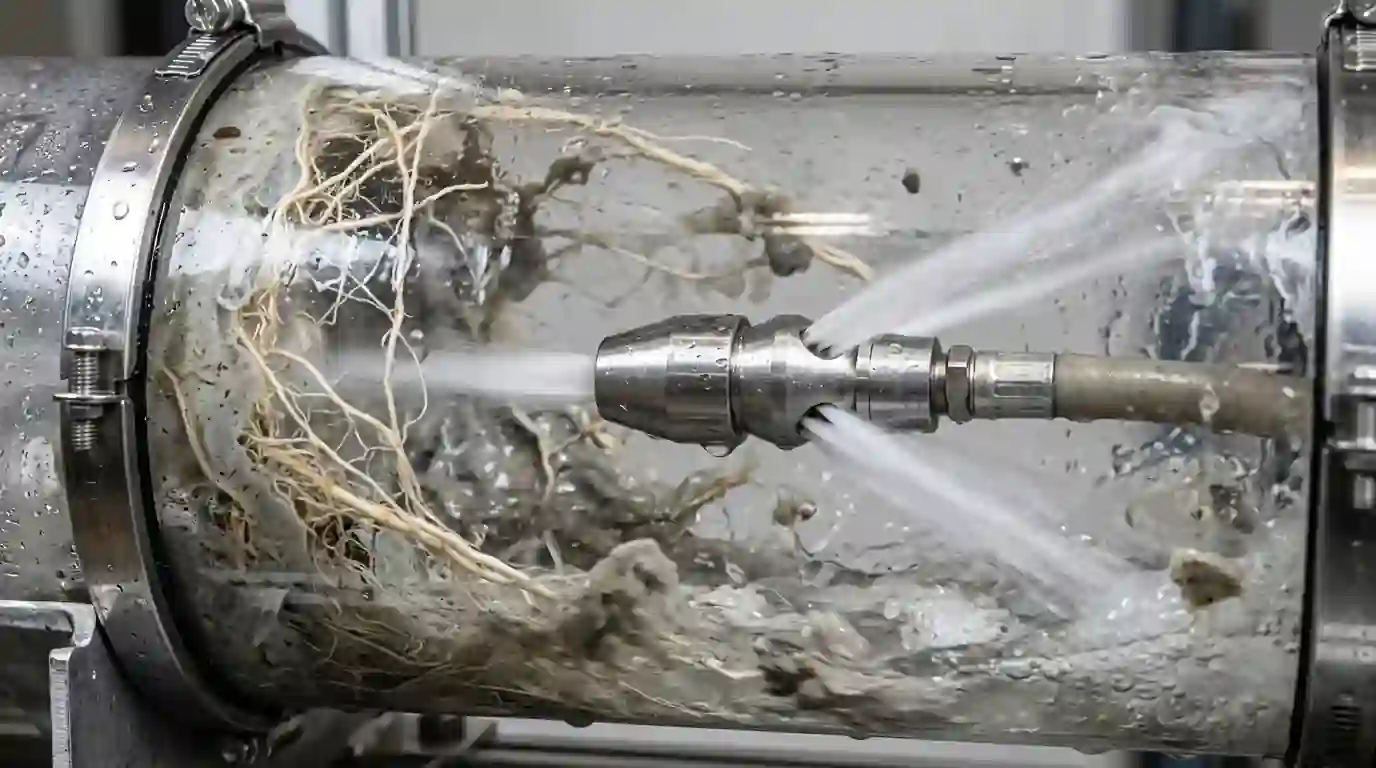
A jetter sends water through a reinforced hose at roughly 3,000 to 4,000 PSI for a sewer main, and lower for small kitchen and laundry lines. The nozzle has jets pointing backward that drive it forward and one or more forward jets that break up the blockage. As we pull the hose back, the rear jets scrub the full circumference and flush the debris toward the city sewer.
The result is a pipe that's close to its original inside diameter. For a kitchen line packed with fat, or a clay lateral full of hair roots, that difference matters. Flow speeds back up, solids move along instead of settling, and the next clog is pushed much further down the calendar.
What hydro jetting costs in Saint Paul
These are typical Saint Paul ranges for residential hydro jetting, not a fixed price. We confirm your price after the camera shows the line, before any jetting starts.
| Job | Typical range |
|---|---|
| Main sewer lateral jetting from an accessible cleanoutIncludes before and after camera runs | $387 to $694 |
| Kitchen or laundry branch line jettingSmaller hose, often through a trap arm | $243 to $412 |
| Heavy root cutting plus jettingDense roots at several clay joints | $611 to $1,047 |
| Cast iron descaling of the mainChain or descaling heads, longer runs | $1,180 to $2,690 |
What moves the price
- Whether there's a usable cleanout or a toilet has to be pulled
- Length of the run from the house to the city main
- How dense the roots or grease are once the camera shows them
- Pipe material and condition, which can mean a lower setting and more passes
- Evening, weekend or holiday timing
- Winter access to an exterior cleanout in frozen ground
Typical Saint Paul ranges. We confirm your price after we see the job and before work starts. See every price on one page.
How hydro jetting goes, start to finish
Find the right access point
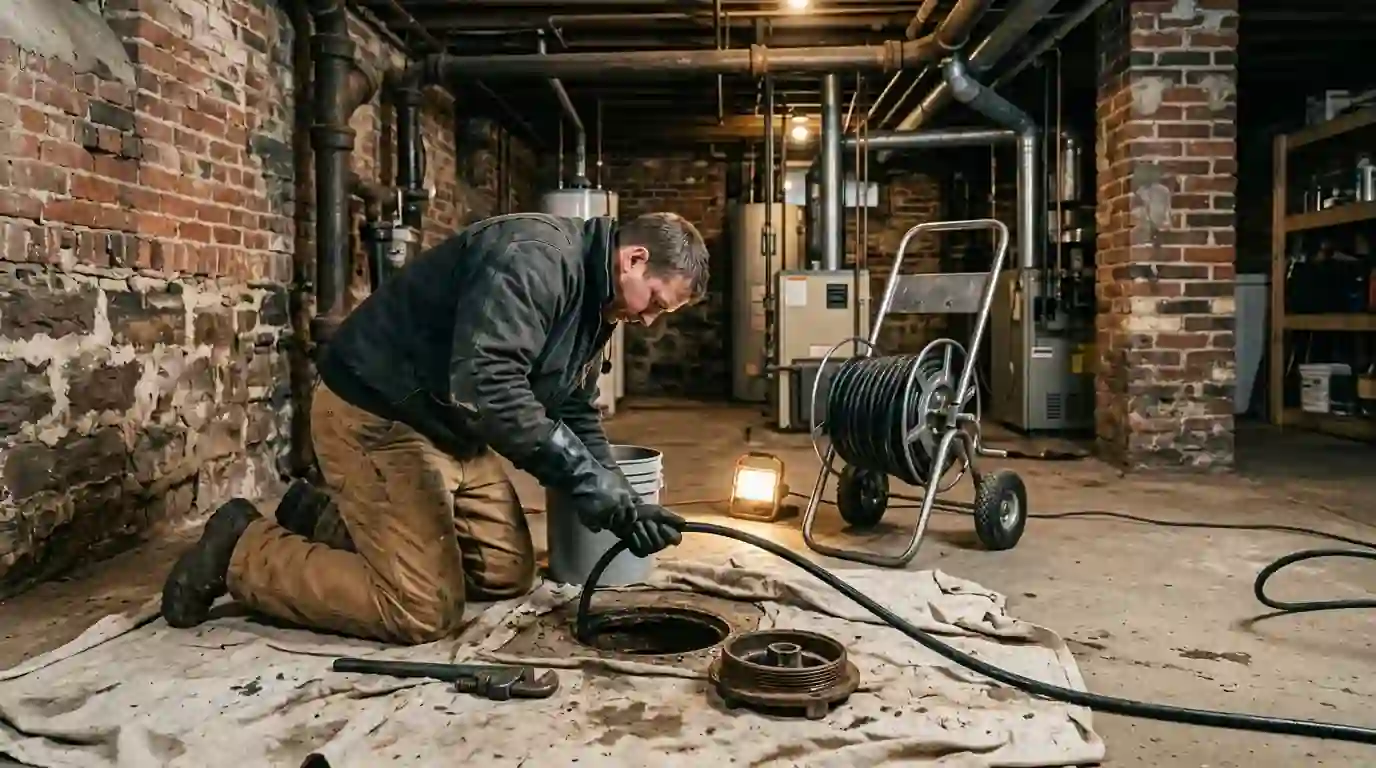
We locate a cleanout, usually at the base of the stack or in the basement floor, or we pull a toilet if there's no usable cleanout.
Camera the line first
A camera run shows the pipe material, the condition of the joints and where the buildup sits, so we pick the right nozzle and pressure.
Protect the work area
We lay down drop cloths and set up a catch tub, because a jetted line throws back water and debris at the opening.
Jet from the cleanout outward
We feed the hose toward the street, cutting roots and breaking up grease, then pull back slowly so the rear jets scrub the whole pipe wall.
Camera the line again
A second run confirms the pipe is clean to the city main and shows you any joint, crack or belly that may need attention later.
Clean up and talk next steps
We rinse the floor, close the cleanout, and give you a plain read on how often that line should be checked or jetted.
Is hydro jetting safe for old pipes?
Usually, yes, as long as the pipe is sound to start with. That's the reason we run a camera before we jet. Water at jetting pressure won't hurt intact cast iron, PVC or clay, but it can make an existing crack worse or push through a joint that has already separated. If the camera shows a broken section, a belly holding water, or an offset joint, we tell you before anything else happens.
In those cases we may jet at a lower setting with a gentler nozzle, clear only up to the damage, or skip jetting and talk about a sewer line repair instead. Jetting a collapsed pipe just washes soil into the line. We would rather show you the footage and let you decide than run a machine through a pipe that can't take it.
Orangeburg, a tar-paper pipe used in some homes built in the 1950s and 1960s, is the one material we won't jet. It softens and deforms with age, and pressure can tear it apart. If your lateral turns out to be Orangeburg, the talk moves to replacement.
Which lines in your house gain the most from jetting
Not every clog needs a jetter. A single hair clog in a bathroom sink is a quick snake job. Jetting earns its cost on lines where buildup is the real problem, not one object stuck in a bend. In Saint Paul homes, that's most often the main sewer lateral and the kitchen branch, followed by laundry lines that carry lint and soap scum.
We size the hose and nozzle to the pipe. A 4 inch or 6 inch sewer lateral gets a larger hose and a root-cutting or chain nozzle. A 1.5 inch kitchen line gets a small, flexible hose that can turn through traps and short bends without getting hung up.
- Main sewer laterals with recurring root intrusion at clay joints
- Kitchen drains coated with years of cooking grease
- Laundry lines choked with lint and detergent sludge
- Cast iron mains with heavy scale ridges
- Basement floor drains that back up during heavy use
How to keep a jetted line clear longer
Jetting resets the pipe, but what goes down it afterward decides how long that lasts. Wipe greasy pans with a paper towel before washing, and let bacon fat cool in a can instead of pouring it in the sink. Hot water and dish soap only carry grease a few feet before it cools and sticks again, usually right where the kitchen line meets the colder basement stack.
For roots, jetting is maintenance, not a cure. The roots came in through a gap in a joint, and they'll find it again. Many homeowners with older clay laterals put the main on a jetting schedule, often every 12 to 24 months, based on how fast the camera shows regrowth. If the cycle starts to feel too short, a lining or a spot repair at the worst joint can end it.
Signs it is time for hydro jetting
The same drain clogs every few months
If a snake clears it and the clog returns within a season, the cable likely bored a narrow hole through buildup that's still lining the pipe.
Gurgling from the floor drain when the washer empties
Air pushed ahead of slow water often means the main is narrowed by sludge, scale or roots somewhere past the cleanout.
A sour smell from the kitchen sink
A rancid odor from a kitchen drain points to years of cooking fat hardened on the pipe wall between the sink and the stack.
Root bits on the snake cable
Fine hair roots on a cable tell you trees are getting into the lateral through joints, and they'll fill back in quickly unless the pipe is scoured.
Slow drains on more than one floor
When the tub upstairs and the basement laundry are both sluggish, the problem is usually in the shared main, not in the fixtures.
Rust flakes or black sludge in a cleanout
Cast iron sheds scale and grows rough ridges inside, and those ridges catch paper and grease until the line chokes.
Why Saint Paul sewer lines collect roots and scale
A large share of Saint Paul houses went up before World War II, and many still drain to the street through clay or cast iron laterals. Clay pipe comes in short sections with joints every few feet, and each joint is a place for roots to slip in. Mature boulevard trees in neighborhoods like Macalester-Groveland, Como Park and Highland Park send fine roots toward those joints, especially during dry summers.
Cast iron has its own problem. Over decades the inside rusts into ridges and bumps that grab paper, grease and lint. In older Dayton's Bluff and West Seventh homes, a camera often shows a main that's lost a good part of its opening to scale. Jetting with the right head clears that out. In winter we carry water on the truck, so a shut-off outdoor faucet doesn't hold up the job.
Where we do hydro jetting
Saint Paul and the surrounding east metro. These are the busiest ZIP codes on our board; the full list has 55 neighborhoods, cities and counties.
Questions about hydro jetting
How often should a Saint Paul sewer line with roots be hydro jetted?
It depends on the pipe and the trees. Many clay laterals with steady root growth do well on a 12 to 24 month cycle. After the first jetting we camera the line, look at how heavy the roots were, then suggest a schedule. If roots grow back in a few months, a spot repair or a lining at the worst joints usually costs less over time.
Can hydro jetting damage cast iron drain pipe?
Sound cast iron handles jetting well, and descaling heads are built for it. The risk is with pipe that's already thin or cracked, which is why we camera first. If the walls look rotted through along the bottom, a common failure in old cast iron, we lower the pressure or recommend a repair instead of jetting a pipe that's about to fail.
Is hydro jetting worth it for a kitchen drain that keeps clogging?
Often, yes. A kitchen line usually clogs because grease coats the full pipe wall, and a snake only cuts a narrow tunnel through it. Jetting removes the coating so the line drains at full width. If your kitchen sink backs up more than once or twice a year, jetting tends to pay for itself in fewer emergency calls.
Do I need to be home while you hydro jet the main line?
We'd like someone there at the start to show us the basement, the cleanout and any fixtures that have given you trouble, and at the end to see the camera footage. In between, it helps to keep everyone from running water or flushing, since the line is open at the cleanout while we work.
Will hydro jetting fix a sewer line with a belly or sag?
No. Jetting cleans out the sludge sitting in a low spot, but the belly itself stays, and it'll collect solids again. We show you the dip on camera and tell you how much water it holds. A shallow one may only need jetting now and then. A deep one usually calls for a repair at that section.
Brands we work on in Saint Paul homes
- Kohler
- Moen
- Delta
- American Standard
- Rheem
- A. O. Smith
- Bradford White
- Navien
- Rinnai
- InSinkErator
- Zoeller
- Liberty Pumps
- Watts
- Weil-McLain
Call the Saint Paul office, day or night
A real person picks up at any hour. Tell us what you are seeing, and we will tell you what happens next and roughly what it costs.
(651) 215-2087- Phone
- Answered 24 hours a day, 7 days a week
- Office
- 289 E 7th Street, Saint Paul, MN 55101
- Headquarters
- 50666 229th Ave, Bemidji, MN 56601
- Coverage
- Saint Paul and the east metro, see all areas