Water service line repair in Saint Paul, MN
A soggy patch in the yard, a sudden drop in pressure or water seeping through the basement wall can all mean the buried line from the street is leaking. We find the problem and get your water back on.
- Phone answered 24/7
- Saint Paul office on E 7th Street
Tell us what you see and hear. We explain the visit and the likely cost on the phone. (651) 215-2087
The short answer
Water service line repair fixes the buried pipe that runs from the curb stop near the street into your house when it leaks, breaks, freezes or gets crushed. You need it if pressure drops suddenly, the yard stays wet or water seeps in where the line enters. We locate the failure, repair or replace the run, and restore service. Typical Saint Paul repairs run $1,280 to $4,690.
When water service line repair cannot wait
A wet spot in the yard that never dries
Grass that stays green and spongy in a line toward the street, even in dry weather, often sits right over a leak.
Pressure dropped all at once
When every faucet in the house weakens at the same time, the problem is often before the meter, in the service line itself.
Water coming through the foundation wall
Seepage around the pipe where it enters the basement can be groundwater, or it can be the supply line itself leaking at the wall.
The meter spins with everything off
Shut every tap and appliance, then watch the meter. If it still moves, water is going somewhere it shouldn't.
No water at all in deep cold
A frozen service line usually means the line is shallow, exposed where it enters, or running through a cold crawlspace.
Rusty or sandy water after street work
Nearby excavation or a main break can disturb old lines. Discoloration that won't clear deserves a look.
What fails on a buried water line
The service line is the pipe that brings water from the city main to your house. In Saint Paul it may be copper, galvanized steel, lead, or on newer homes, plastic. Each fails in its own way. Galvanized steel rusts from the inside and outside until it pinholes. Copper can corrode in aggressive soil or wear where it rubs against a rock. Old lead lines crack at joints. Plastic can split from a bad fitting or root pressure.
Ground movement plays a role too. Frost heave lifts and drops soil every winter, and over decades that stress opens joints and crimps pipe at the foundation. Tree roots wrap around lines. And any time a neighbor or the city digs nearby, an old brittle line can take a hit. Knowing the pipe material tells us a lot about what we're likely to find.
How we handle water service line repair once we arrive
Confirm the leak is in the service line
We run a meter test with every fixture off and inspect the curb stop, foundation entry and shutoff valve.
Trace and listen
We trace the line's route and use acoustic equipment to pinpoint where water is escaping underground.
Call locates and permit
We request public utility markings and pull the city permit before digging.
Expose the pipe
We dig a pit over the leak, shore it safely, and look at the pipe condition with you.
Repair or replace
We cut in a new section or pull a new line, depending on what we find.
Test, flush and restore
We pressure test, flush the line, backfill in layers and put the surface back.
What water service line repair costs in Saint Paul
These are typical Saint Paul ranges for service line repair. Every yard is different, so we confirm the price after locating the problem.
| Job | Typical range |
|---|---|
| Leak location and line traceCredited toward the repair if we do the work | $237 to $418 |
| Spot repair with small excavationOne leak, average depth and access | $1,280 to $2,690 |
| Frozen service line thawUnderground freezes cost more | $318 to $847 |
| Full private side replacementTrenchless or open trench, run length dependent | $3,840 to $8,670 |
What moves the price
- How deep the line is and the soil conditions
- Concrete, pavers, trees or retaining walls over the leak
- Pipe material and whether nearby sections are also failing
- Frozen ground in winter that slows excavation
- Distance from curb stop to the house
- Whether the main shutoff or meter valves also need replacing
Typical Saint Paul ranges. We confirm your price after we see the job and before work starts. See every price on one page.
How we find the leak without tearing up the yard
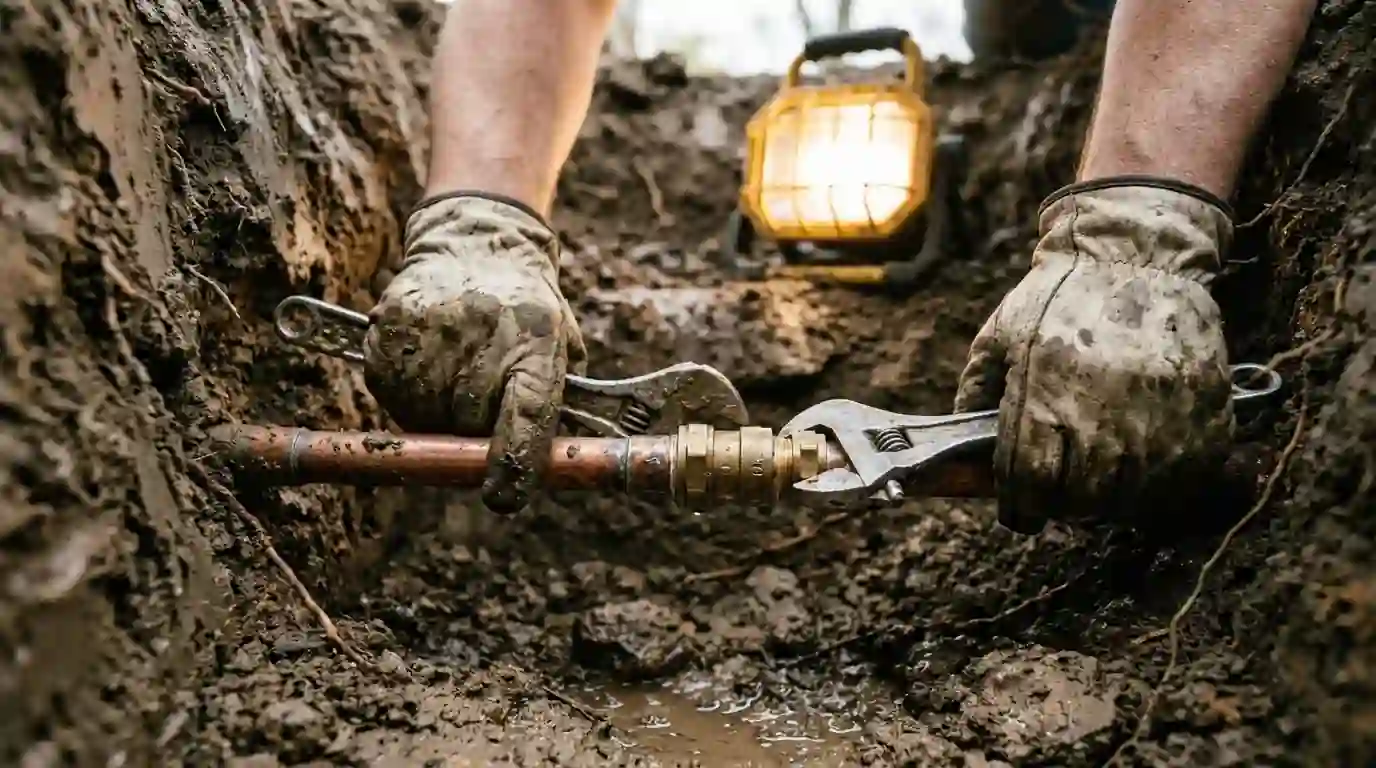
We start at the meter. A leak test with all fixtures off tells us whether water is escaping before the meter or after it. Then we look at the curb stop, the foundation entry and the yard for clues. Acoustic listening equipment picks up the hiss of water escaping from a pressurized pipe underground, which lets us narrow the location before any digging starts.
If the line is metallic, we can trace its route with a locator so we know exactly where it runs. That matters because old service lines don't always go straight from the street to the house. Before excavation, we call for public utility locates so gas, electric and communication lines are marked. Then we dig a small pit right over the leak instead of trenching the whole yard.
Repair a section or replace the whole line?
A single leak on a line that's otherwise in good shape can be repaired by cutting out the bad section and installing a new piece with approved couplings. That's often the fastest way to get water back. But if the pipe is galvanized and badly corroded, or if it's lead, patching just moves the problem a few feet down the line. In those cases replacement is the better use of your money.
We'll show you the condition of the pipe once it's exposed. If it looks sound on both sides of the leak, we repair it. If it's thin, pitted or flaking, we'll explain the cost difference of replacing the full run. For lead lines, we'll talk about coordinating with SPRWS, since the public side may need attention too.
- Spot repair: one leak, healthy pipe on either side
- Partial replacement: a bad stretch near the house or curb
- Full replacement: galvanized, lead or repeated failures
- Trenchless pull: new line pulled through with two small pits
When your water line freezes
Service lines are supposed to run deep enough to stay below frost, but older lines aren't always buried as deep as they should be. Lines that enter under a porch, run through an unheated crawlspace, or sit under a driveway where snow is cleared and frost goes deeper are the most likely to freeze. When it happens, you'll usually have no water at any tap.
Never use a torch or open flame on a frozen service line. Open a faucet nearest where the line enters and keep the basement warm. Then call us. We use methods that warm the line safely from inside the house, and if the frozen section is underground, we can use specialized thawing equipment. Afterward, we look at why it froze and what would stop it from happening again.
Getting water back on and the yard put back together
Once the repair is made, we slowly bring the line back up to pressure, check for leaks at every joint, and flush the line so any dirt that got in is cleared out. We also check the main shutoff valve inside the house, since an old gate valve that won't fully close can make future repairs harder. Replacing it while the water's already off is easy.
We backfill and compact the soil in layers so it doesn't sink later. Sod or seed goes back where the grass was removed. If we had to cut a sidewalk or driveway, we'll go over the patching plan with you. We pull the city permit for service line work and schedule the inspection, and we'll let you know when water will be off and for how long.
Service line trouble in Saint Paul yards and basements
Saint Paul's older blocks are full of service lines that date back many decades, often galvanized steel or lead, running under boulevard trees and sidewalks laid long after the pipe. In neighborhoods like Como Park, West Seventh and the Greater East Side, mature trees and heaving sidewalks are common, and both can stress a buried line. Many houses also have the line entering through a fieldstone or block wall that was never well sealed.
Winters here are the other big factor. A deep cold snap with little snow cover drives frost further into the ground, and shallow or exposed lines freeze. Spring brings the opposite, saturated soils that make leaks harder to spot. Homes in Roseville and Maplewood with long setbacks have longer runs to the street. We work through all four seasons, and the phone is answered 24/7 when you've lost water.
Where we do water service line repair
Saint Paul and the surrounding east metro. These are the busiest ZIP codes on our board; the full list has 55 neighborhoods, cities and counties.
Questions about water service line repair
Who is responsible for a leaking water service line in Saint Paul?
Generally, the homeowner is responsible for the private side of the service line, from the curb stop to the house, and the water utility handles the public side up to the curb stop. Exact responsibility can depend on your address and situation, so check with SPRWS. We repair the private side and coordinate if the public side is involved.
How can I tell if my water line is leaking underground?
Turn off every faucet and water-using appliance, then check the meter. If the dial or leak indicator still moves, water is escaping. A wet strip of lawn toward the street, a sudden pressure drop or water at the foundation entry are other clues. We can confirm it with a meter test and acoustic listening equipment.
Can you repair a frozen water service line in a Saint Paul winter?
Yes. We thaw service lines safely from inside the house when the freeze is near the foundation, and use specialized thawing gear for frozen sections deeper underground. We never use open flame. After thawing, we check for any split pipe, since frozen lines can crack, and suggest ways to prevent it from freezing again.
How long will my water be off for a service line repair?
A spot repair is often finished the same day, with water back on within several hours once the pipe is exposed. A full replacement may take a day or two, depending on trenching and access. We'll give you a realistic timeline before starting, and suggest filling some jugs and the bathtub ahead of time.
Brands we work on in Saint Paul homes
- Kohler
- Moen
- Delta
- American Standard
- Rheem
- A. O. Smith
- Bradford White
- Navien
- Rinnai
- InSinkErator
- Zoeller
- Liberty Pumps
- Watts
- Weil-McLain
Call the Saint Paul office, day or night
A real person picks up at any hour. Tell us what you are seeing, and we will tell you what happens next and roughly what it costs.
(651) 215-2087- Phone
- Answered 24 hours a day, 7 days a week
- Office
- 289 E 7th Street, Saint Paul, MN 55101
- Headquarters
- 50666 229th Ave, Bemidji, MN 56601
- Coverage
- Saint Paul and the east metro, see all areas