Tankless water heater installation and service in Saint Paul, MN
A tankless water heater heats water only when you open a tap, so you don't run out during back-to-back showers. We size, install and service gas tankless units for Minnesota's cold incoming water.
- Phone answered 24/7
- Saint Paul office on E 7th Street
Tell us what you see and hear. We explain the visit and the likely cost on the phone. (651) 215-2087
The short answer
A tankless water heater heats water on demand as it flows through, instead of storing a tank of hot water. It suits homes that run out of hot water or want basement space back. Installation means a larger gas line, new venting and a mounting spot on the wall. Yearly descaling keeps it running. Typical Saint Paul range: $3,870 to $6,940 installed.
How a tankless heater works with Minnesota's cold water
When you open a hot tap, water flows through the unit, a sensor detects it, and a gas burner fires to heat the water as it passes through a heat exchanger. There's no tank to empty, so hot water keeps flowing as long as the unit can keep up with the demand. The catch is that it can only raise the water temperature so much at a given flow rate.
That matters in Minnesota. In January, water coming into the house is much colder than in summer, so the unit has to work harder to bring it up to shower temperature. A heater that handles two showers in July may only handle one and a half in February. We size for winter conditions, not the brochure, so you get full performance year round.
Most homes we install use gas condensing models from makers such as Navien and Rinnai, which vent through plastic pipe out a side wall.
What tankless water heaters costs in Saint Paul
Typical Saint Paul ranges for tankless water heater installation and service. We confirm the price after checking your gas supply, venting and mounting spot.
| Job | Typical range |
|---|---|
| Gas condensing tankless, replacing a tank heaterIncludes venting and permit | $3,870 to $6,940 |
| Gas line upsizing from the meterDepends on run length and pipe size | $587 to $1,840 |
| Descaling and annual serviceIncludes filter cleaning and check | $213 to $367 |
| Tankless repair after diagnosisSensors, igniters, fans or boards | $247 to $783 |
What moves the price
- Unit size and flow rate needed for winter demand
- Gas line upsizing from the meter
- Vent route length and wall or roof penetration
- Condensate drain and neutralizer
- Mounting location and access
- Permit and inspection
Typical Saint Paul ranges. We confirm your price after we see the job and before work starts. See every price on one page.
How tankless water heaters goes, start to finish
Size for winter demand
We count fixtures, ask about simultaneous use, and size the unit for Minnesota's coldest incoming water.
Check the gas supply and venting path
We measure the gas meter and pipe size and plan the vent route out a wall or roof before quoting a final price.
Pull permits and remove the old heater
We pull the city permit, shut off and drain the old tank, and carry it out.
Mount and connect the unit
We mount the tankless heater, run the gas line, venting, water connections, condensate drain and isolation valves.
Start up and test
We purge the gas line, fire the unit, check for leaks, test flow and temperature at several taps, and confirm venting.
Walk you through care
We show you the error display, the filter and the descaling valves, and set a reminder for the first service.
What a tankless installation involves in an older home
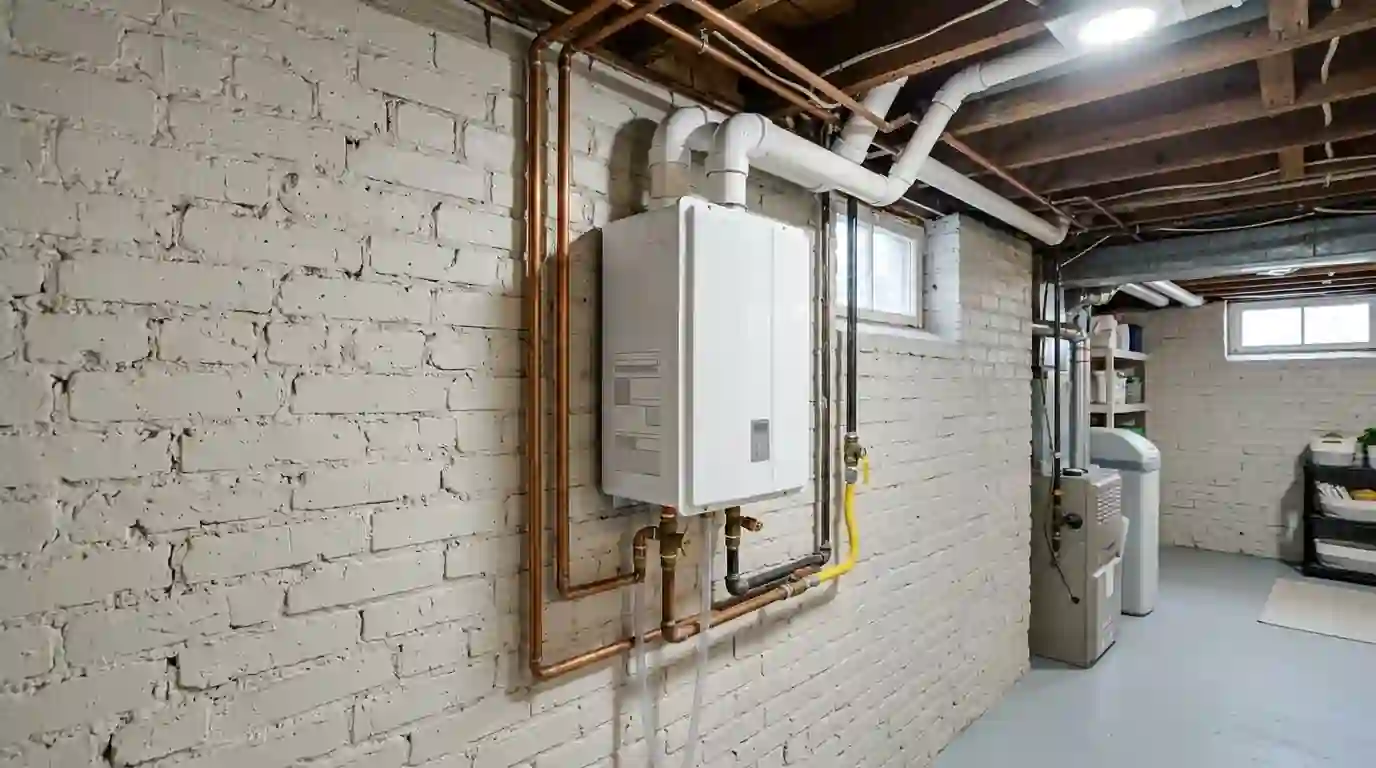
Tankless installs take more than a straight swap. A whole-house gas tankless unit can draw far more gas than a tank heater, so the gas line often needs to be upsized from the meter. That's one of the biggest variables in cost. We check your meter, the existing pipe size and the length of the run before we give you a price.
Condensing models vent through PVC pipe out a side wall or the roof, and they produce acidic condensate that needs a drain, often with a neutralizer. We also add isolation valves so the unit can be flushed easily, and we pull the city permit for the gas, venting and plumbing work.
- Gas line sized for the unit's full demand, from the meter if needed
- New PVC intake and exhaust venting through a side wall or roof
- Condensate drain with a neutralizer where required
- Isolation valves for easy descaling
- Wall mounting with clearance for service
- Electrical outlet for the unit's controls
Is tankless worth it for your household?
Tankless heaters make the most sense for households that run out of hot water with a tank, want floor space back, or plan to stay in the house long enough to benefit from lower gas use. The upfront cost is higher than a tank, mostly because of the gas line and venting work, so the payback depends on your use and how long you'll stay.
They're not perfect for everyone. There's a short delay before hot water reaches the tap, and very small draws like rinsing a cup may not trigger the burner. In hard water areas, they need yearly descaling to keep working well. We'll give you an honest comparison with a standard or high-efficiency tank so you can decide.
Keeping a tankless unit running: descaling and service
Minerals in your water slowly build up inside the heat exchanger. As scale thickens, it insulates the water from the heat, which cuts output and can cause overheat errors. In hard water areas, we recommend descaling once a year. Elsewhere, every one to two years is usually enough.
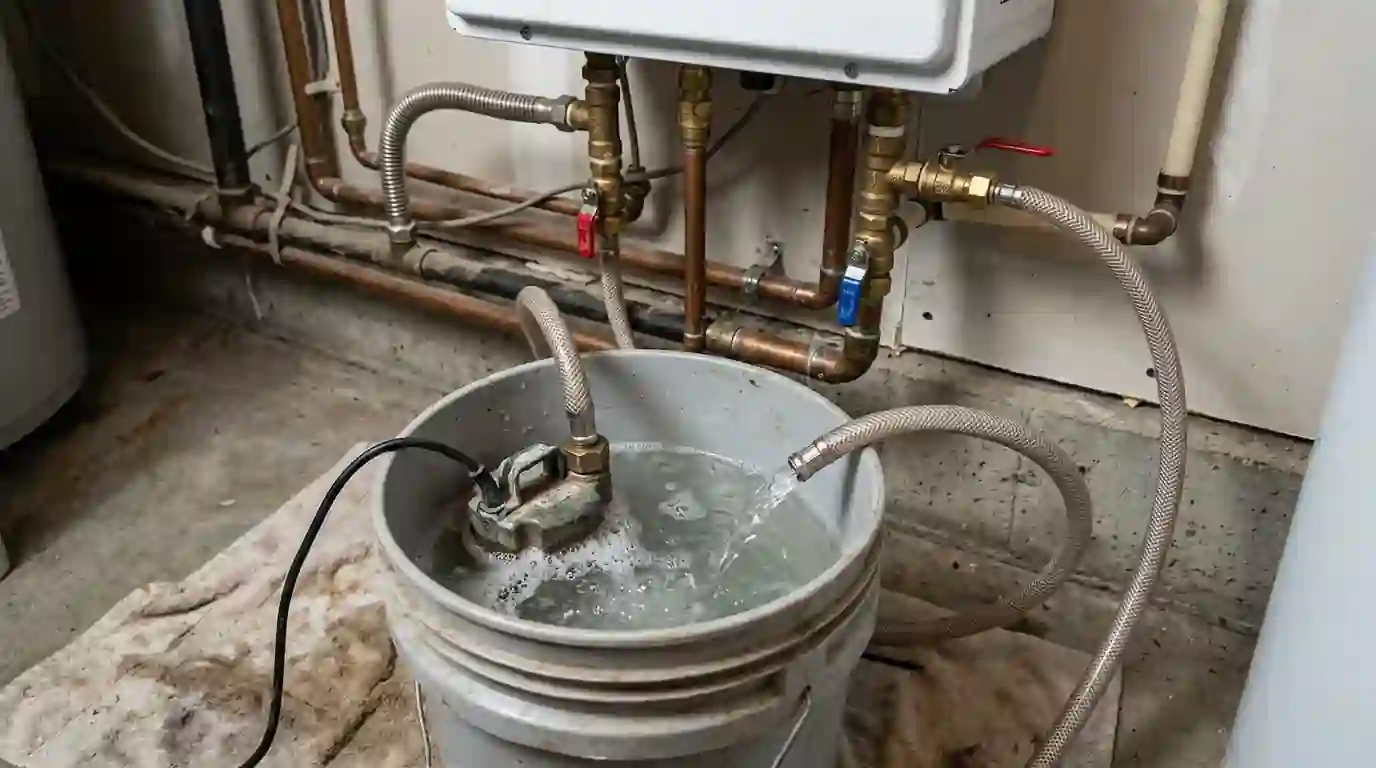
Descaling means connecting a small pump to the isolation valves and circulating a mild descaling solution through the unit for about an hour, then flushing it clean. While we're there, we clean the inlet water filter, check the burner and venting, and look up any error codes the unit has stored. Most tankless repairs we see could have been prevented by regular descaling.
Signs it is time for tankless water heaters
You run out of hot water every morning
A tankless heater sized correctly keeps up with back-to-back showers instead of emptying a tank and waiting to recover.
Your tank heater is near the end of its life
Replacement time is the natural moment to weigh switching to tankless, since you're paying for venting and connections anyway.
You want floor space back in the basement
A wall-mounted tankless unit opens up the corner where a 50 gallon tank used to stand.
Your tankless unit shows an error code
Codes for flame failure, venting or overheating often trace back to scale, a clogged filter or a gas supply that's too small.
Water temperature swings during showers
Bursts of cold or uneven heat from a tankless unit usually point to scale on the heat exchanger or a flow problem.
It's been more than a year since a descaling
Minerals build up inside the heat exchanger, and in hard water areas that buildup cuts output and shortens the unit's life.
Tankless heaters in Saint Paul homes and east metro suburbs
Many older Saint Paul homes have small gas lines sized decades ago for a stove, a furnace and a tank heater. In neighborhoods like Macalester-Groveland, Highland Park and St. Anthony Park, a tankless install often means a new gas run from the meter. Basement walls of stone or brick also take some planning for venting, but a side wall exit is usually possible.
In Woodbury, Cottage Grove and other east metro suburbs with hard water, scale is the biggest threat to a tankless unit. We recommend yearly descaling there, and a water softener protects the heat exchanger even more. Homeowners who switch tend to appreciate the steady hot water most in January, when a tank heater struggles to recover with near-freezing incoming water.
Where we do tankless water heaters
Saint Paul and the surrounding east metro. These are the busiest ZIP codes on our board; the full list has 55 neighborhoods, cities and counties.
Questions about tankless water heaters
Will a tankless water heater keep up with two showers at once in a Minnesota winter?
It can, if it's sized for winter. Cold incoming water in January means the unit has to raise the temperature more, which cuts its flow rate. We size for the coldest months, so a correctly sized unit should handle two showers at once. An undersized one may not, which is the most common complaint we hear.
Why does my tankless water heater need descaling every year?
Minerals in the water build up inside the heat exchanger, which cuts heating output and can trigger overheat errors. In hard water areas, a yearly descale keeps the unit working well and extends its life. In softer water, every one to two years is usually enough.
Do I need a bigger gas line for a tankless water heater?
Often, yes. A whole-house tankless unit can use much more gas at full fire than a tank heater. Many older homes have gas pipe that's too small, so we check the meter and line size and upsize the pipe from the meter if needed. Skipping this causes error codes and poor performance.
How long does a tankless water heater last compared with a tank?
A well-maintained tankless unit often lasts longer than a standard tank, frequently 15 years or more, and many parts can be replaced individually. Without descaling in hard water, though, the heat exchanger can scale up and fail early. Regular service makes the biggest difference.
What does a tankless water heater error code mean?
Each brand uses its own codes, but common ones point to ignition failure, venting problems, overheating from scale, or low gas pressure. Note the code, then call us. Many problems come from a clogged inlet filter or scale, which a service visit clears.
Brands we work on in Saint Paul homes
- Kohler
- Moen
- Delta
- American Standard
- Rheem
- A. O. Smith
- Bradford White
- Navien
- Rinnai
- InSinkErator
- Zoeller
- Liberty Pumps
- Watts
- Weil-McLain
Call the Saint Paul office, day or night
A real person picks up at any hour. Tell us what you are seeing, and we will tell you what happens next and roughly what it costs.
(651) 215-2087- Phone
- Answered 24 hours a day, 7 days a week
- Office
- 289 E 7th Street, Saint Paul, MN 55101
- Headquarters
- 50666 229th Ave, Bemidji, MN 56601
- Coverage
- Saint Paul and the east metro, see all areas