Well pump and pressure tank service near Saint Paul, MN
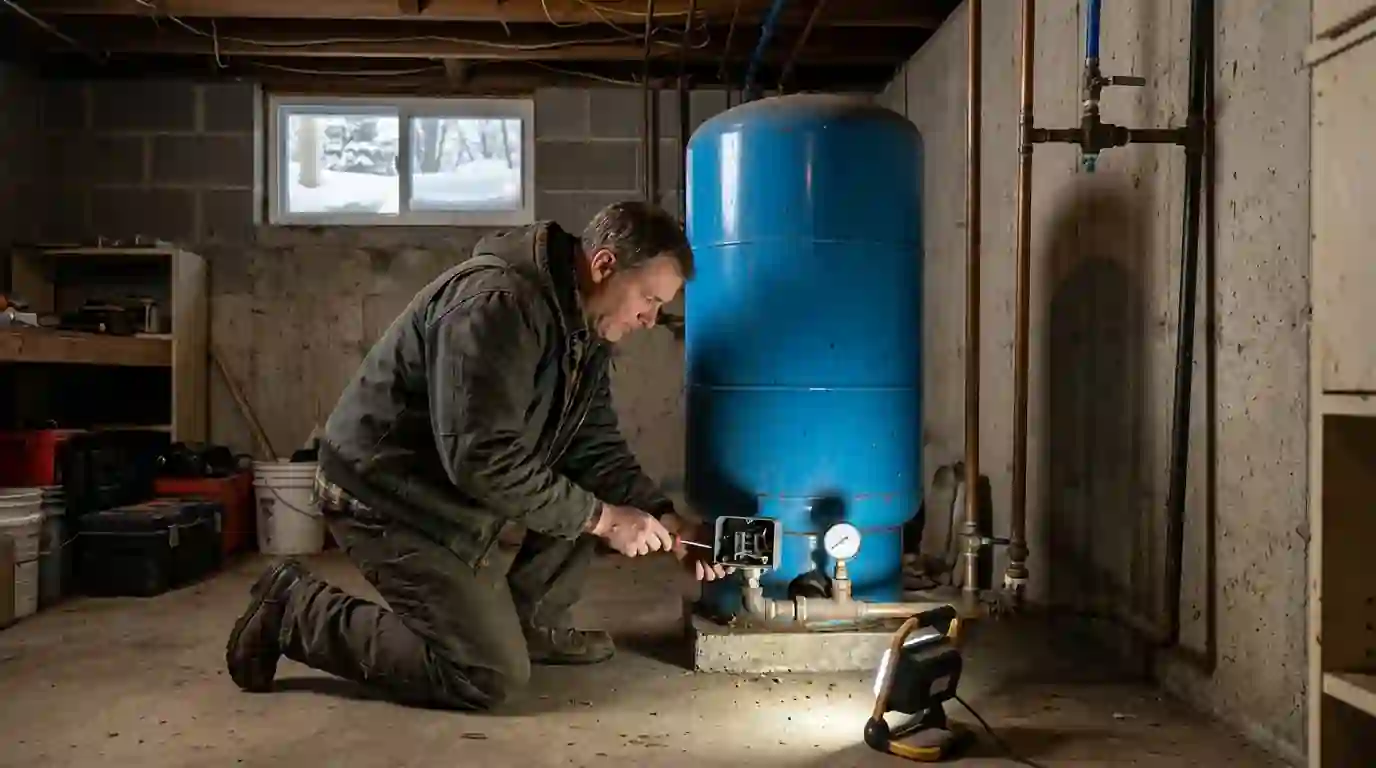
When a house runs on a private well, every faucet depends on one pump, one tank and one small switch. If any of them quits, the water stops, and we come out to find which one and get it running again.
- Phone answered 24/7
- Saint Paul office on E 7th Street
Tell us what you see and hear. We explain the visit and the likely cost on the phone. (651) 215-2087
The short answer
Well pump and pressure tank service covers the submersible or jet pump that lifts water, the pressure tank that stores it, and the switch that tells the pump when to run. You need it when water stops, pressure surges, or the pump clicks on and off constantly. We test each part, repair or replace the failed one, and restore pressure. Typical Saint Paul area range: $213 to $467 for diagnosis and common repairs.
When well pump and pressure tank service cannot wait
No water at any faucet
If you lose water and you are on a well, check the breaker for the pump first, then call us before trying to reset anything twice.
Pressure that pulses or surges
Water that goes strong, weak, strong again while a shower runs often points to a pressure tank that has lost its air charge.
The pump clicks on and off every few seconds
Rapid short cycling wears out the motor and switch quickly, so it's worth getting looked at before the pump burns out.
Air spitting from faucets
Sputtering taps can mean the water level in the well has dropped near the pump intake, or that a pipe or fitting is pulling in air.
A breaker that keeps tripping
A pump motor drawing too much current or a damaged wire down the well can trip the breaker, and that is not a reset-and-forget problem.
Sand, grit or cloudy water
Sediment in the water can mean a worn pump, a damaged screen, or a pump set too close to the bottom of the well.
An electric bill that jumped for no clear reason
On a well there's no water bill to warn you, so a pump that runs far more than usual shows up on the power bill instead, often because of a hidden leak or a failing check valve.
What to check first if you lose water on a well
If the faucets go dry and you're on a private well, start at the electrical panel. Look for a tripped double breaker labeled well or pump. If it's tripped, reset it once. If it trips again, leave it off and call us, because repeated resets can damage a motor that's already struggling or heat up a bad wire.
Next, look at the pressure gauge on or near the tank. A reading near zero with the breaker on tells us the pump isn't running or isn't delivering water. A normal reading with no water at the taps points somewhere else, like a closed valve or a clogged filter. Note what you see and give us a ring; it helps us bring the right parts.
Please don't open the well cap, pull wiring, or tap on the pressure switch with the power on. Well systems run on 230 volts in most homes, and that's work we handle with the power safely off.
How we handle well pump and pressure tank service once we arrive
Hear what happened
We ask when the water changed, what the gauge reads, whether the breaker tripped, and how old the pump and tank are if you know.
Check power and controls
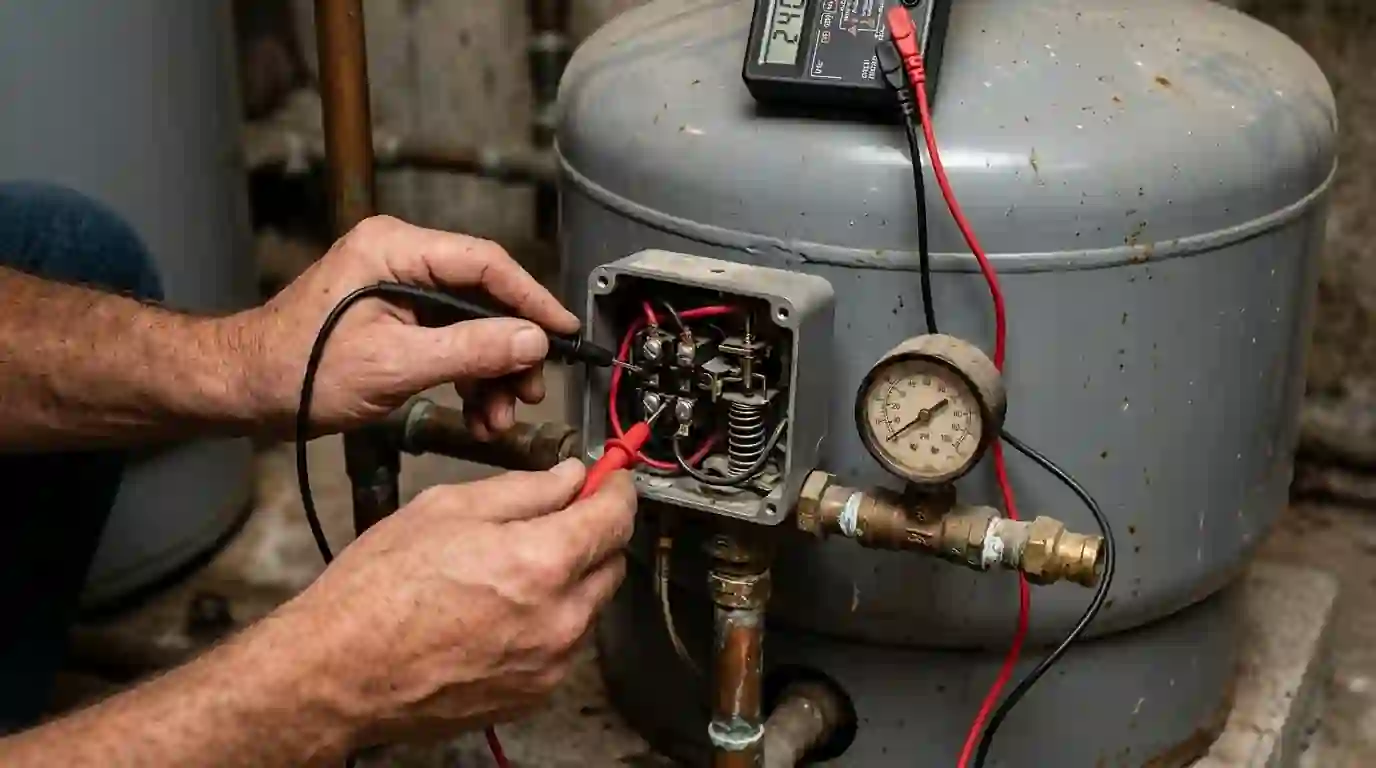
With proper safety steps, we test voltage at the switch and control box, and check capacitors and relays on systems that use them.
Test the pressure tank
We drain the system, read the tank's air charge, and check the bladder for water where only air should be.
Read the pump from the surface
We measure motor amps and wire resistance to tell a healthy pump from a failing one before anything is pulled.
Make the repair
We replace the failed switch, tank, control part or pump, and set the tank charge to match the switch settings.
Run the system through full cycles
We open faucets, watch the pump start and stop, confirm steady pressure, and check every new fitting for leaks.
What well pump and pressure tank service costs in Saint Paul
Typical ranges for well pump and pressure tank work at homes around Saint Paul. The price is confirmed after we see your setup and test the parts.
| Job | Typical range |
|---|---|
| Diagnosis and pressure switch replacementIncludes testing the full system | $213 to $367 |
| Pressure tank replacementSize of tank moves this most | $873 to $1,640 |
| Jet pump replacementAbove-ground pumps on shallower wells | $1,170 to $2,290 |
| Submersible pump replacementDepth of the pump and wire run matter | $2,380 to $4,670 |
| Control box or capacitor repairThree-wire submersible systems | $187 to $343 |
What moves the price
- How deep the pump is set and how much pipe and wire must be pulled
- Pump horsepower and whether the wire down the well needs replacing
- Tank size and how much room there is around the old one
- Whether the switch, tank and pump are replaced together
- Pump house or crawlspace access versus an open basement
- Night, weekend or holiday calls when the house has no water
Typical Saint Paul ranges. We confirm your price after we see the job and before work starts. See every price on one page.
How a pump, tank and pressure switch work together
A well system has three main parts. The pump lifts water out of the ground. Most newer homes use a submersible pump down in the well casing, while some older or shallow wells use a jet pump mounted in the basement or a pump house. Either way, it pushes water into the house plumbing and into a pressure tank.
The pressure tank holds a cushion of air above a bladder or diaphragm. As water fills it, the air compresses and builds pressure. When you open a faucet, that stored pressure pushes water out, so the pump doesn't have to start for every glass of water. The pressure switch watches the gauge and turns the pump on at a low setting and off at a high one.
When any one of those parts fails, the others feel it. A waterlogged tank makes the switch cycle the pump constantly. A worn switch can leave the pump running nonstop. Testing all three is how we find the real cause.
- Submersible pump: sits deep in the well casing, wired from the surface
- Jet pump: sits above ground, common on older or shallow wells
- Pressure tank: stores water under air pressure to cut pump starts
- Pressure switch: turns the pump on and off at set pressures
- Check valve: keeps water from draining back down the well
Short cycling, and why it shortens the life of a well pump
Short cycling is when the pump turns on and off over and over in a short time, often every few seconds while a faucet runs. Every start puts a surge of current through the motor and a jolt through the pipes. A pump is built to start a reasonable number of times a day, and rapid cycling burns through that much faster.
The usual cause is a pressure tank that has lost its air charge or has a torn bladder. Without that air cushion, the tank holds almost no water, so pressure drops the moment you open a tap and the pump kicks on. A clogged switch tube, a leaking check valve, or a tank that's simply too small for the house can cause the same pattern.
We check the tank's air charge with the system drained, test the switch, and look for leaks before deciding whether a recharge, a new switch or a new tank is the right fix.
Repair or replace: making the call on a failing pump
Not every well problem means a new pump. A burned switch contact, a failed capacitor in the control box, or a waterlogged tank can all stop the water while the pump itself is fine. Those repairs are quicker and cost far less, so we rule them out before recommending anything that involves pulling the pump from the well.
When the pump is the problem, we measure motor current and resistance from the surface to confirm it. Replacing a submersible pump means lifting the pipe and wire out of the casing, which takes equipment and a careful crew. We'll explain what we found, what replacement involves at your well, and what the typical cost range looks like before any work starts.
If the pump is older and the tank and switch are also worn, replacing them together can save a second visit down the road.
Private wells in the communities around Saint Paul
Inside Saint Paul, homes get city water, but drive a short way north or east and private wells become common. In Hugo, Lake Elmo, Forest Lake and Lino Lakes, plenty of houses sit on larger lots outside city water service, with a submersible pump in the yard and a pressure tank in the basement or utility room. Many of those systems were installed when the house was built and haven't been touched since.
Minnesota winters add their own trouble. A pressure tank or jet pump in an unheated pump house or garage can freeze, and the pipe running from the well to the house needs to stay below the frost line. In spring, hard rain and snowmelt can stir up sediment in some wells. Washington County and Anoka County homes also tend to have hard water, which builds scale in the pressure switch tube and fittings over time.
Where we do well pump and pressure tank service
Saint Paul and the surrounding east metro. These are the busiest ZIP codes on our board; the full list has 55 neighborhoods, cities and counties.
Questions about well pump and pressure tank service
What should I do if my well pump stops and the house has no water?
Check the panel for a tripped well pump breaker and reset it once. If it trips again or the pressure gauge stays near zero, turn the breaker off and call us. Don't keep resetting it, and don't open the well cap or touch the wiring. The line is answered 24/7, so call (651) 215-2087 any time.
How do I know if my well pressure tank is waterlogged?
A waterlogged tank usually shows up as the pump clicking on and off every few seconds while a faucet runs, and pressure that pulses up and down. If you knock on the tank, a full tank sounds dull all the way up instead of hollow near the top. We confirm it by draining the system and checking the air charge.
Can you replace a submersible well pump in Lake Elmo or Hugo in one visit?
In many cases, yes. Once we confirm the pump is the problem, we pull the pipe and wire, set the new pump, and restore water the same day when parts and access allow. Very deep wells, damaged wire or a stuck pump can stretch the job. We'll tell you up front what to expect at your well.
How often should I have my well water tested in Washington or Anoka County?
The Minnesota Department of Health generally suggests private well owners test for coliform bacteria every year and check for nitrate and certain other contaminants on a regular schedule. Testing after flooding or any repair that opens the well is wise too. We work on pumps and tanks, and we can tell you when a repair should be followed by a water test.
Does a new pressure switch fix a well pump that runs constantly?
Sometimes. A switch with burned or stuck contacts can keep the pump running nonstop, and replacing it fixes that. But a pump that runs all the time can also mean a leak in the line, a failing check valve, or a worn pump that can't reach the cutoff pressure. We test each one so the switch isn't replaced for nothing.
Jobs that often go with well pump and pressure tank service
Brands we work on in Saint Paul homes
- Kohler
- Moen
- Delta
- American Standard
- Rheem
- A. O. Smith
- Bradford White
- Navien
- Rinnai
- InSinkErator
- Zoeller
- Liberty Pumps
- Watts
- Weil-McLain
Call the Saint Paul office, day or night
A real person picks up at any hour. Tell us what you are seeing, and we will tell you what happens next and roughly what it costs.
(651) 215-2087- Phone
- Answered 24 hours a day, 7 days a week
- Office
- 289 E 7th Street, Saint Paul, MN 55101
- Headquarters
- 50666 229th Ave, Bemidji, MN 56601
- Coverage
- Saint Paul and the east metro, see all areas