A large share of Saint Paul houses were built before World War II, and many still have some or all of their original galvanized steel water pipe. It was the standard choice for decades. The catch is that galvanized pipe corrodes from the inside, slowly closing the opening until a full stream becomes a weak trickle, and eventually the pipe leaks at the threads.
Galvanized pipe rarely fails all at once, so it's easy to live with it a long time without realizing how much it's affecting your water. This guide explains how to tell if you have it, the signs it's near the end, how much of it really needs replacing, and what a repipe looks like in an older house.
The short version
- Galvanized pipe is gray steel with threaded joints, and a magnet sticks to it.
- Falling pressure, rusty water and leaks at threads are the main warning signs.
- Galvanized pipe downstream of an old lead service line can trap lead particles.
- Replacing basement mains first often helps pressure throughout the house.
- A full repipe usually beats chasing leaks once failures start piling up.
How to tell if you have galvanized pipe
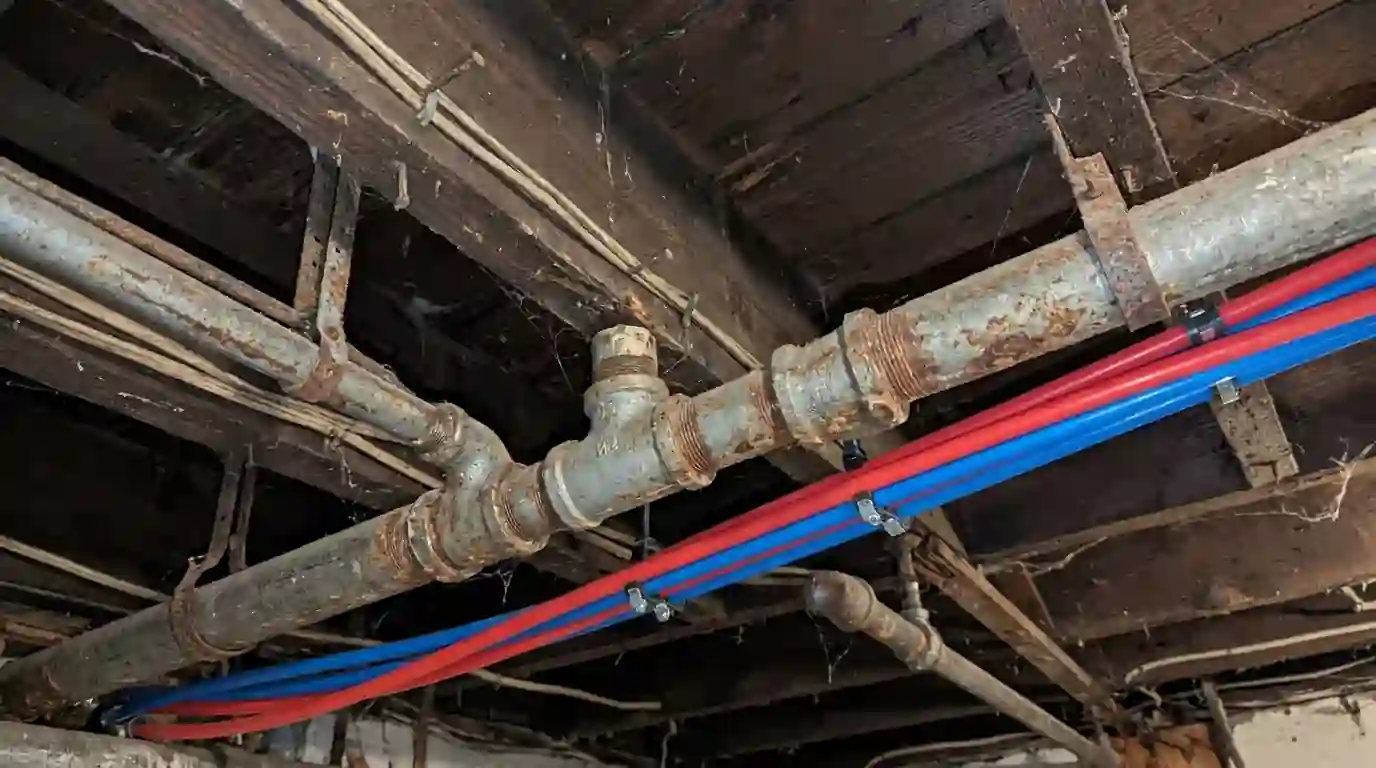
Galvanized pipe is dull silver gray steel with threaded joints. Look in the basement ceiling or at the pipes running up from the water heater. If you see threaded fittings, and a magnet sticks firmly to the pipe, it's galvanized steel. Copper scratches to a penny color and won't hold a magnet. PEX is plastic, usually red, blue or white.
Many homes have a mix. A previous owner may have replaced the basement mains with copper but left galvanized pipe inside the walls, running up to bathrooms and the kitchen. Or the reverse: copper upstairs from a remodel, and galvanized still in the basement. Check every section you can see, including under sinks and behind access panels.
Warning signs galvanized pipe is wearing out
Low water pressure that gets worse over time is the most common sign. Rust and scale build up inside the pipe, narrowing it a little each year. You may notice it first upstairs, where water has to travel farthest. Pressure at the kitchen sink drops when someone flushes a toilet, and showers turn weak when the washer runs.
Rusty or brown water, especially after the water sits overnight or after a plumber shuts the house down for work, is another sign. So are pinhole leaks and drips at threaded joints, where the pipe wall is thinnest. If you've had one leak repaired in the past year or two, others are usually not far behind on the same lines.
- Water pressure that has dropped over the years, worst upstairs
- Brown or rusty water after it sits or after a shutoff
- Drips or rust stains at threaded joints
- Pinhole leaks in exposed sections
- A pressure drop at one fixture when another is used
- Hot water side failing first, since heat speeds up corrosion
Why galvanized pipe can matter for water quality
Galvanized pipe is coated with zinc, and in older pipe that coating may carry small amounts of other metals. More importantly, in houses that once had a lead service line, or still do, galvanized pipe downstream of that lead can trap lead particles in its rough, corroded inner walls and release them later.
That doesn't mean every galvanized pipe is a problem for drinking water, but it's one more reason to know what your service line is made of. If you have galvanized pipe and an old service line you're unsure about, a scratch and magnet test at the entry point is a good first step, and replacing both together is often the cleanest plan.
Can you replace galvanized pipe a section at a time?
Yes, and many homeowners do. A common first step is replacing the basement mains, the larger pipes that feed the whole house. That alone can improve pressure everywhere, since the main lines carry all the water. Typical Saint Paul ranges for a partial repipe of the basement mains run about $1,870 to $3,640.
The tradeoff is that remaining galvanized pipe in the walls keeps aging. And every time a plumber cuts into an old line, the threaded joints nearby get stressed and sometimes start leaking. If your home has galvanized pipe running through most walls and the pressure is poor upstairs, a full repipe usually makes more sense than chasing leaks one at a time.
What a whole-house repipe involves
A repipe replaces every water supply line in the house, usually with PEX for the runs through walls and copper at the water heater and main shutoff. We plan the routes to keep openings in plaster or drywall small, often running new lines through closets, basement ceilings and existing chases. Water is usually off for part of each work day, not the whole job.
Typical Saint Paul ranges run about $5,470 to $8,390 for a one bath home and $7,960 to $11,840 for a two bath, two story home. What moves the price: number of bathrooms and fixtures, plaster versus drywall, how many floors, access from the basement and attic, copper versus PEX, and whether the main shutoff or service line gets replaced at the same time. We pull the city permit.
- Walk through the house and map every fixture
- Plan routes that keep wall openings small
- Run new lines and connect fixtures room by room
- Pressure test the new system
- Patch access openings and remove old pipe where reachable
Signs it's time to stop patching
If you've had two or more leaks on galvanized lines in a short span, if pressure upstairs is weak enough to make showers frustrating, or if you're planning a kitchen or bath remodel, it's a good time to talk about replacing the pipe. Remodels are an especially good moment, since walls are already open and the new fixtures deserve a full flow.
Give us a ring at (651) 215-2087 and we'll take a look at what you have, check pressure at a few fixtures, and lay out options from partial to full repipe. The line is answered 24/7, and if a galvanized joint is leaking right now, close the main shutoff and we'll get out to you.
Need a hand with this? Call (651) 215-2087. The line is answered 24/7.